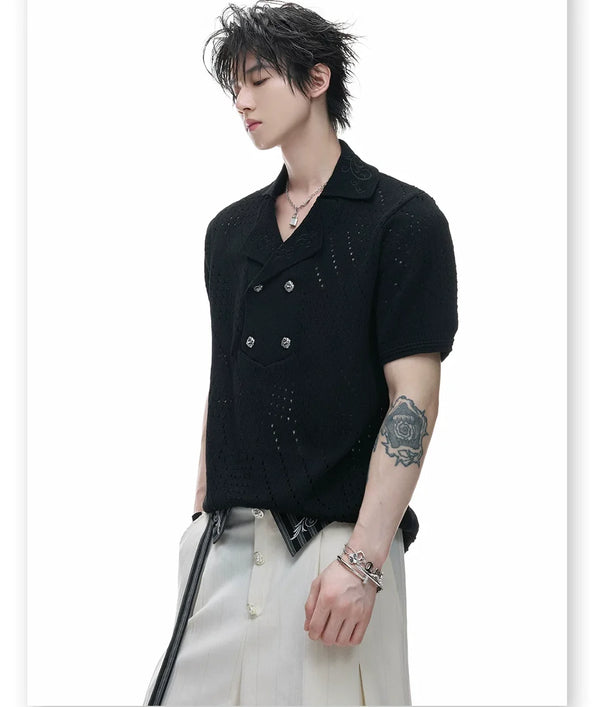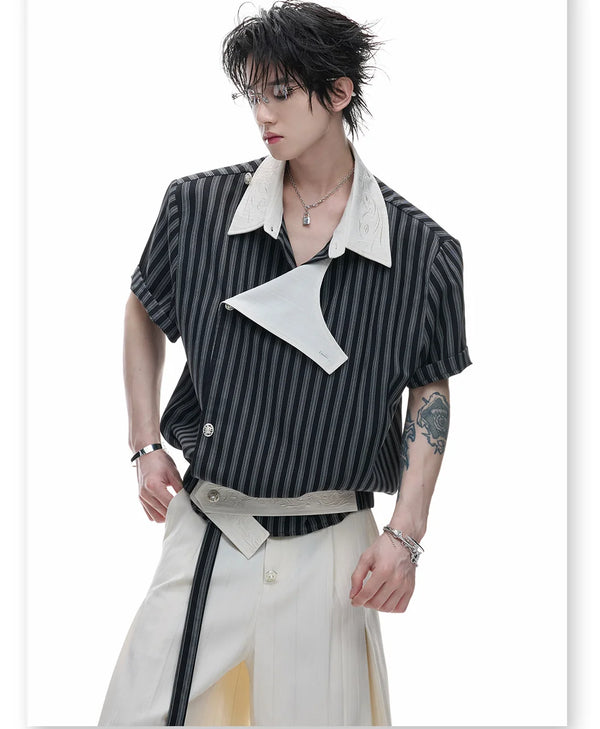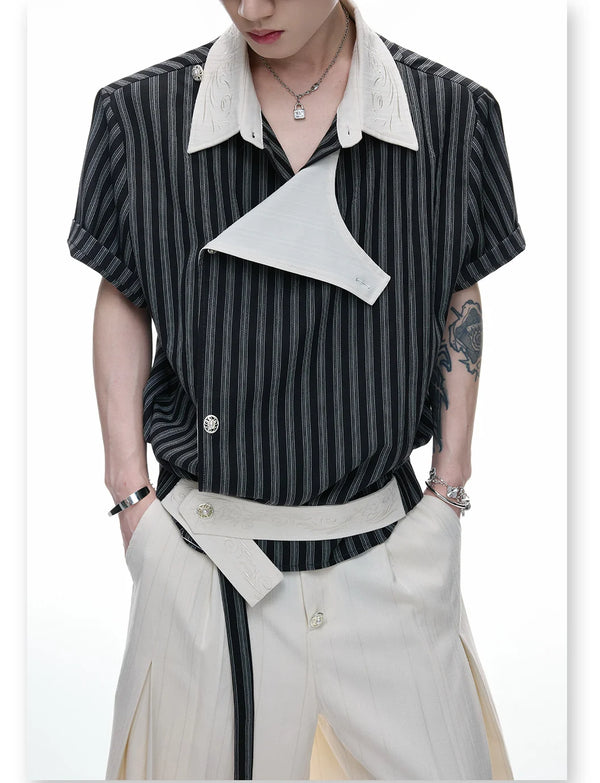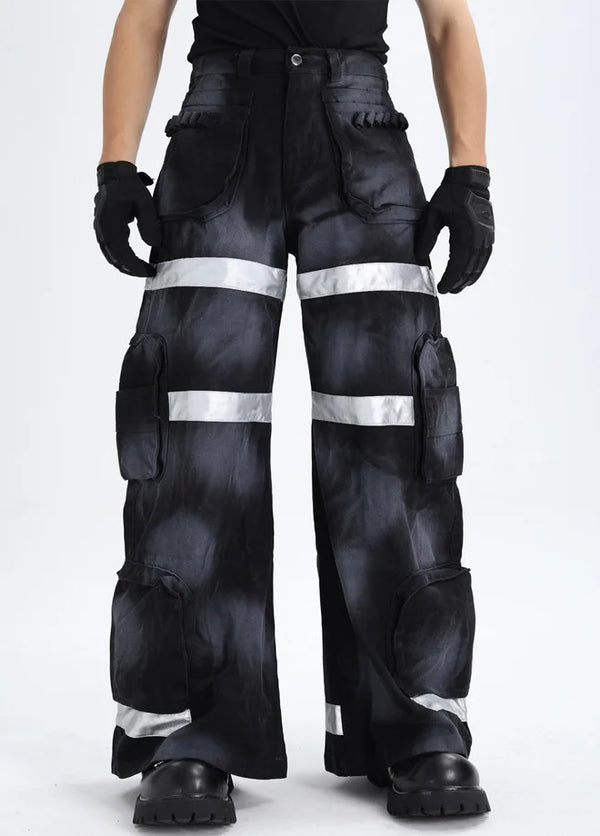

Contents 8 sections
- 01 The 4-slot Opium formula
- 02 Silhouette equation: tight on top, wide on the bottom
- 03 Four Opium outfit archetypes — to style directly
- 04 Shoes, hardware, sunglasses — the finisher grammar
- 05 Six break points where the Opium look collapses
- 06 Verdict: Opium calculates, doesn't improvise
- 07 Frequently asked questions about dressing Opium
- 08 Frequently asked questions about dressing Opium
Four slots, two silhouettes, three finishers — Opium needs nothing more. And still, the look collapses on most attempts before the first photo is shot. The top too tame, the pants too skinny, the chain in gold. Opium is not a blacklist of brands, it's an equation.
Dark clothes ≠ Opium. Wear only black and you land in Gothic, Techwear or Streetwear — not Opium. The trend lives on a concrete silhouette equation, a hard hardware rule, and a slot architecture that reduces every outfit to exactly four parts. The moment one of them slips, the look reads as costume instead of signature.
You walk away with: the 4-slot formula, the tight-on-top-wide-on-bottom equation including a 4-combination matrix, four named Opium archetypes to style directly, and a 6-point list of the executional fails where the look reproducibly breaks. No inspiration — a manual.
📖 This article is part of our Opium Fashion Guide
This guide covers the styling mechanics — slot architecture, silhouette equation, finisher grammar. The aesthetic itself, its history and its sub-styles are explained by the cluster pillar.
🎥 Opium in motion: the silhouette geometry
@fugastudios silver demons walk among us 👁️ Opium Metallic Pants eating up the competition fr fr
Follow us on TikTok for more style inspiration! 🖤
The 4-slot Opium formula
Opium reduces every outfit to four slots. Not five, not three. The mistake on most attempts: they think in Pieces instead of slots, buy one dark piece after another, stack on top of each other, and wonder why the look ends up reading as Goth-Emo or sack Streetwear. The slot logic is the blueprint you have to hold up in front of the mirror every time — before the Pieces come into play.
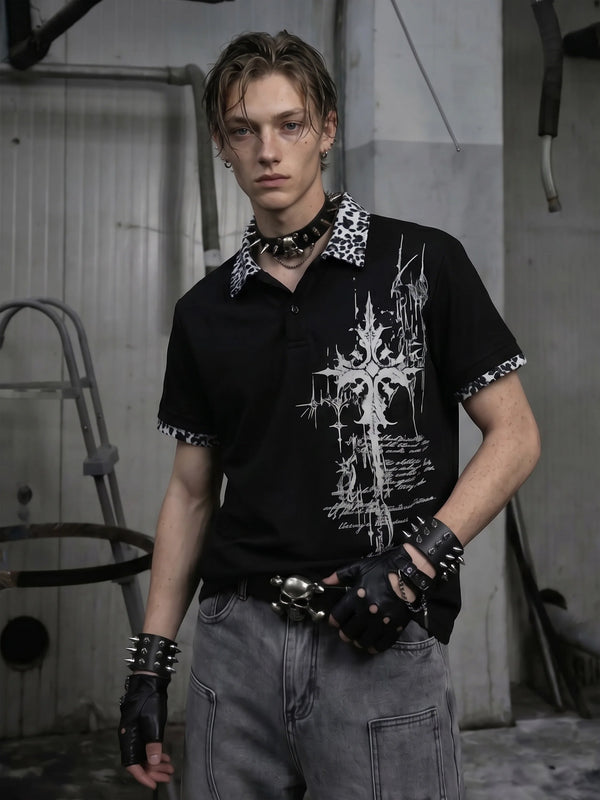
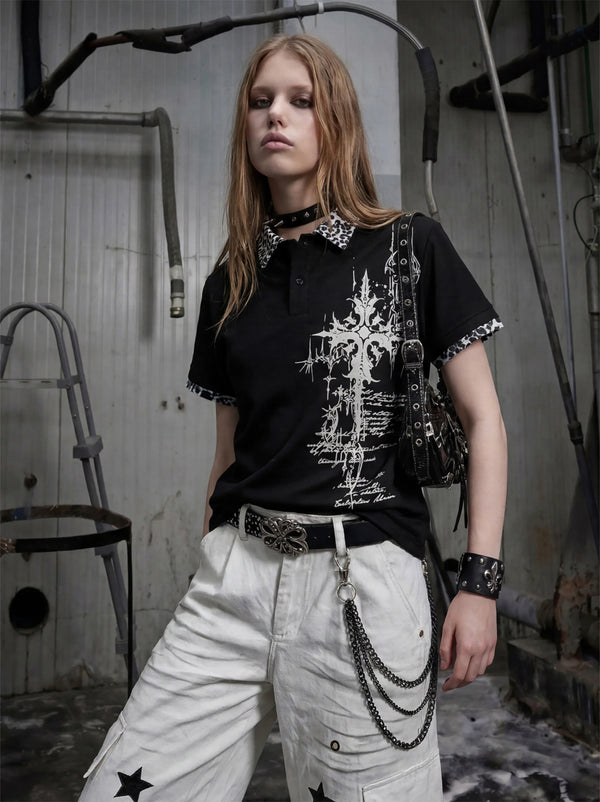
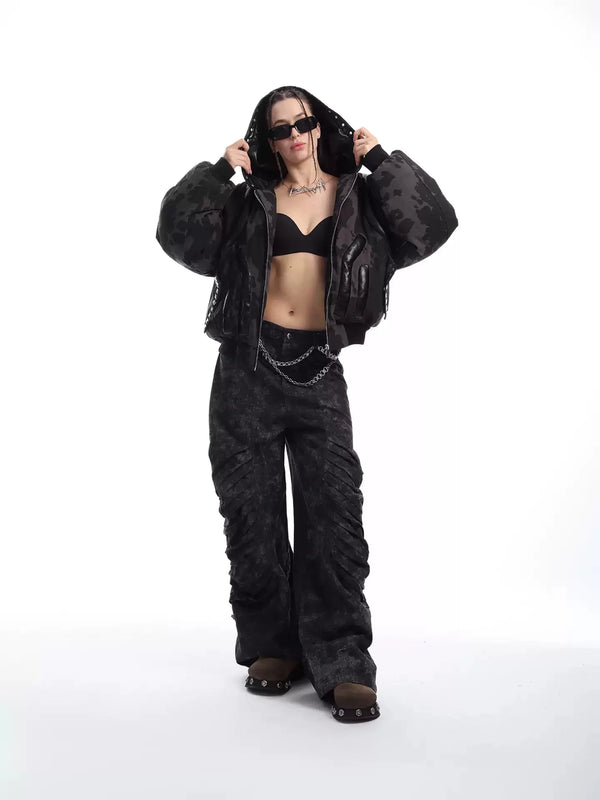
Slot 1 — Top. Fitted or graphic. A tank, a mesh longsleeve, a cropped hoodie, a T-shirt with a specific graphic or a posture-emphasizing seam. What a top is NOT: an oversize shirt that hangs loose over the hips. Opium shows the silhouette up top — the top is the tight chamber, not the wide one.
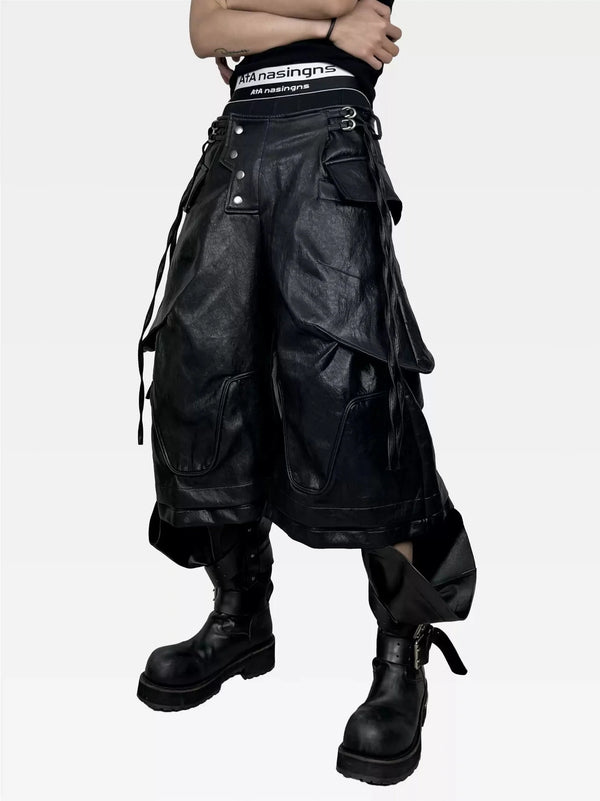
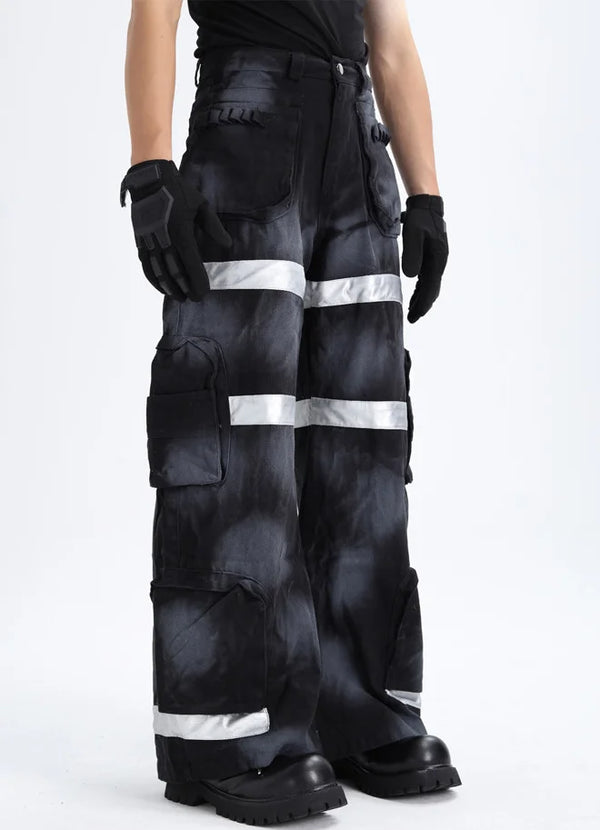
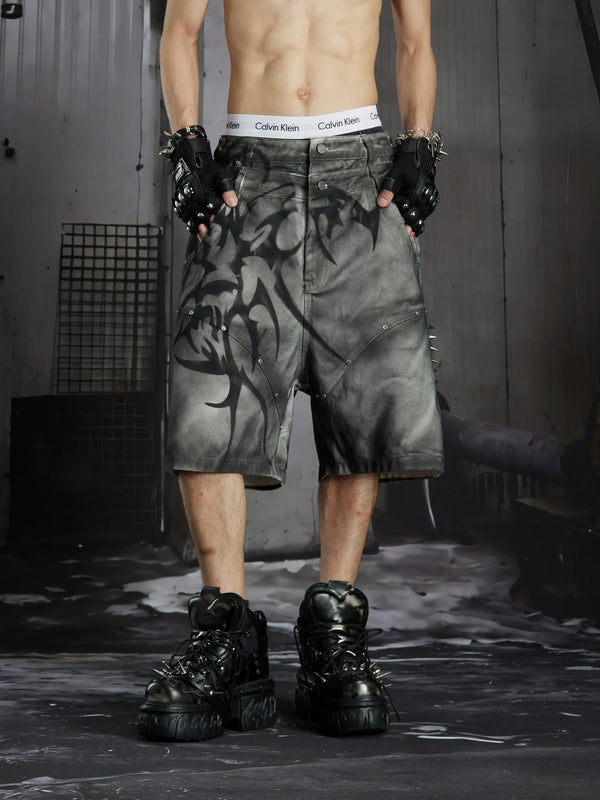
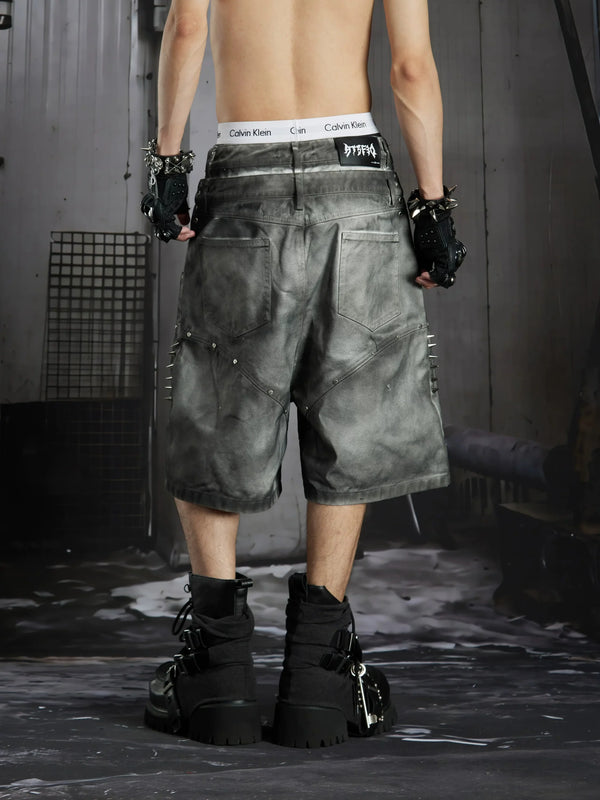
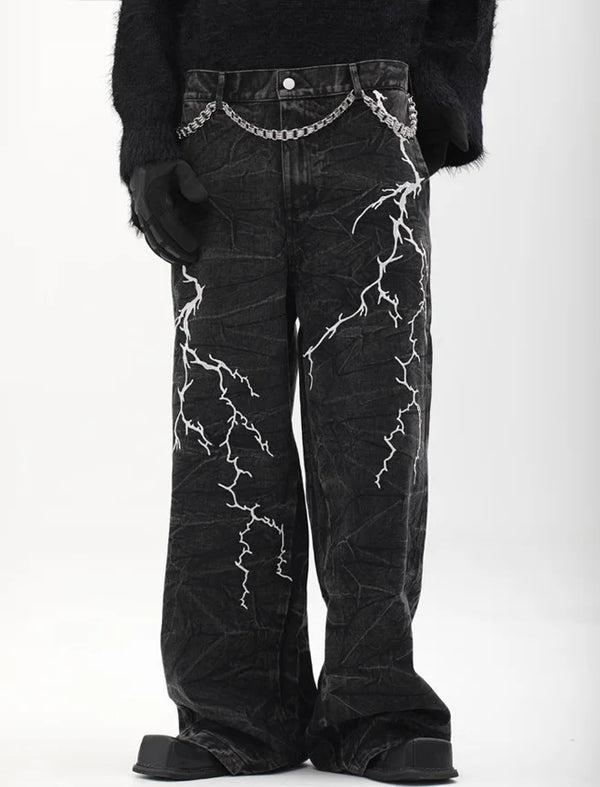
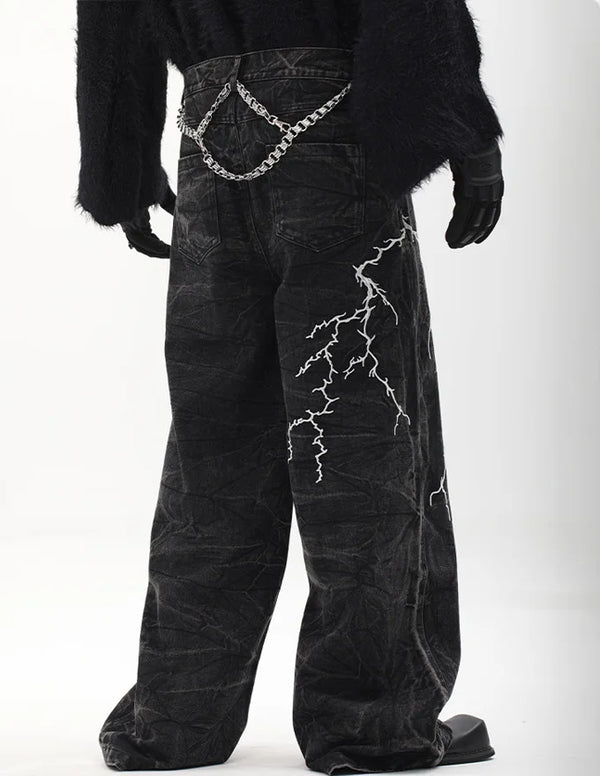
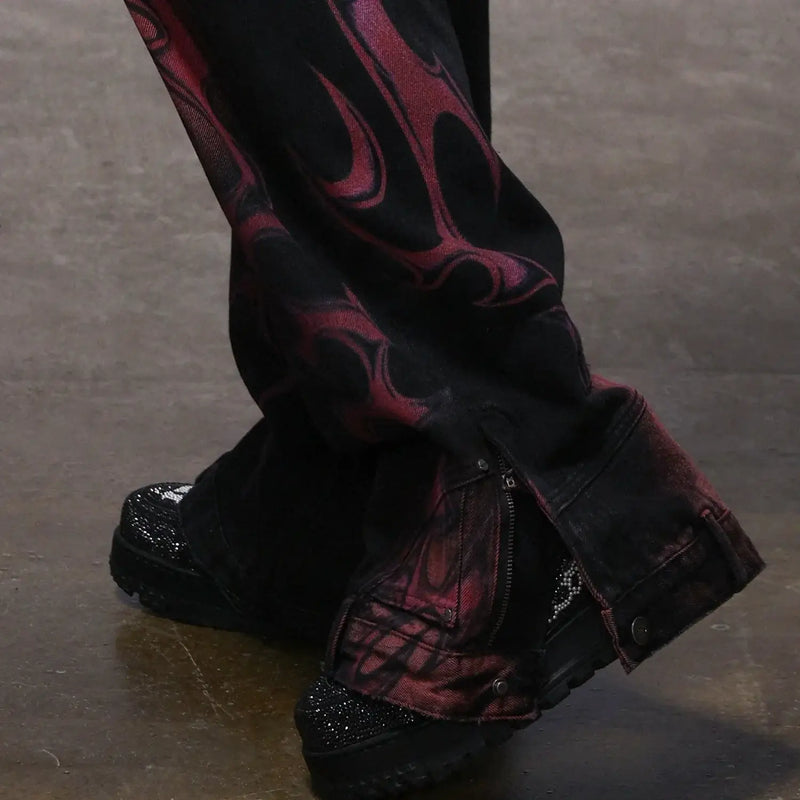
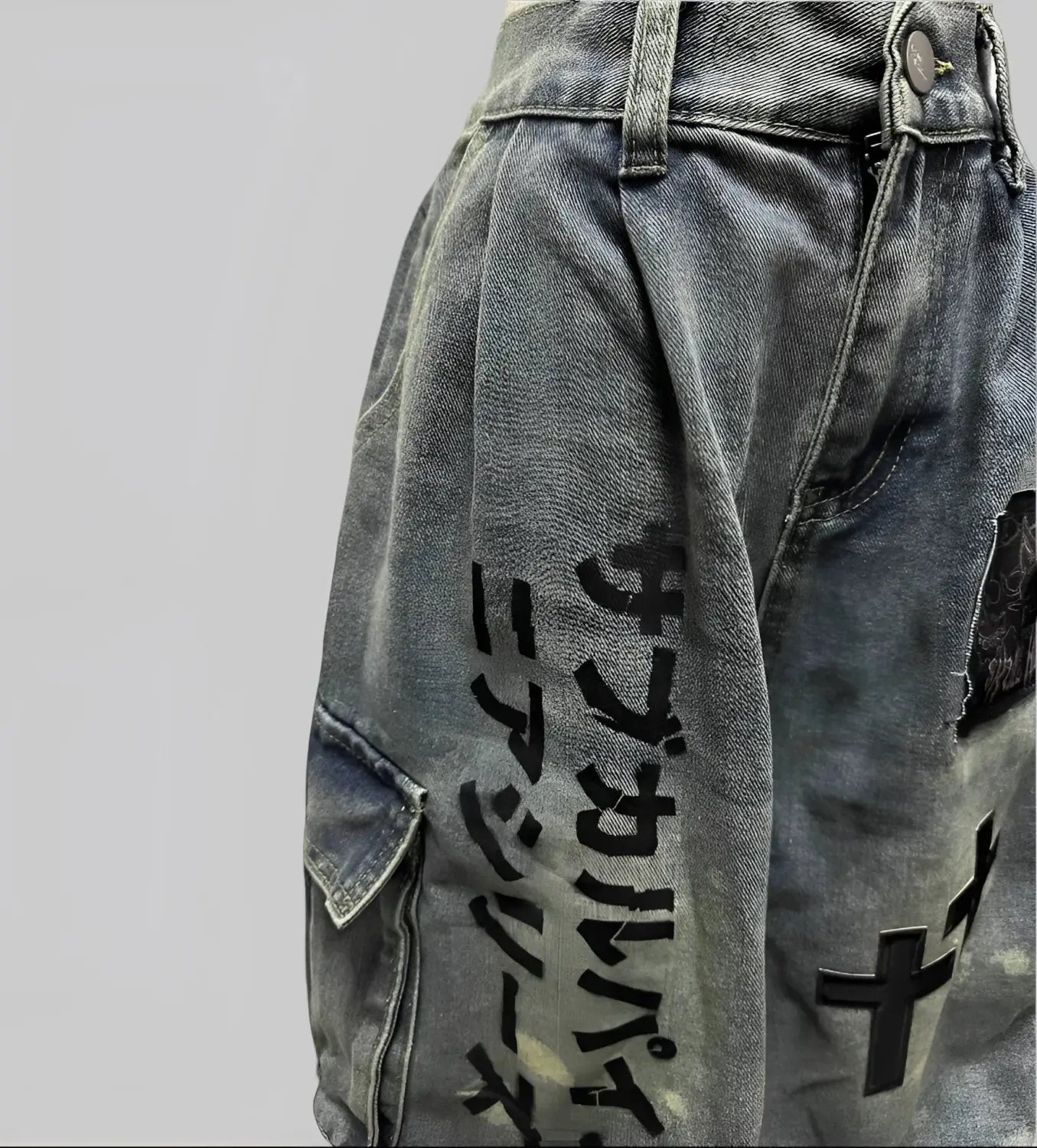
Slot 2 — Bottom. Wide. Wide-leg jeans, cargo pants with multipocket, leather pants in a boot cut, occasionally a stirrup harness over the jeans. The pants always carry the volume of the outfit. Slim jeans and skinny pants are foreign to Opium — they belong to late-2010s rapper Streetwear, not the Carti era.
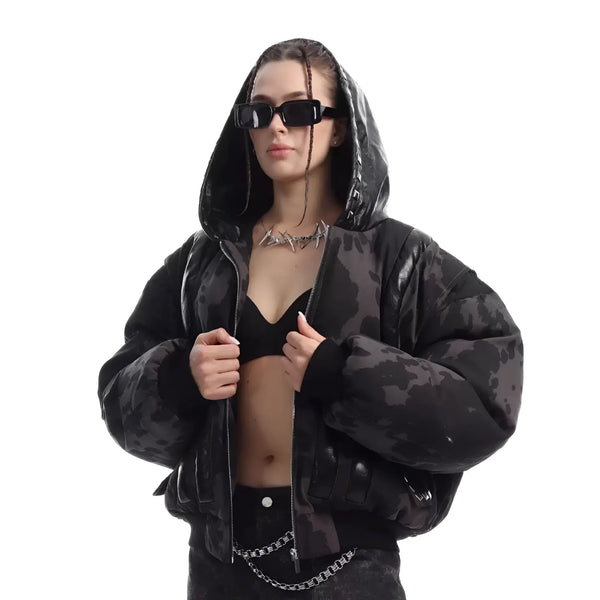
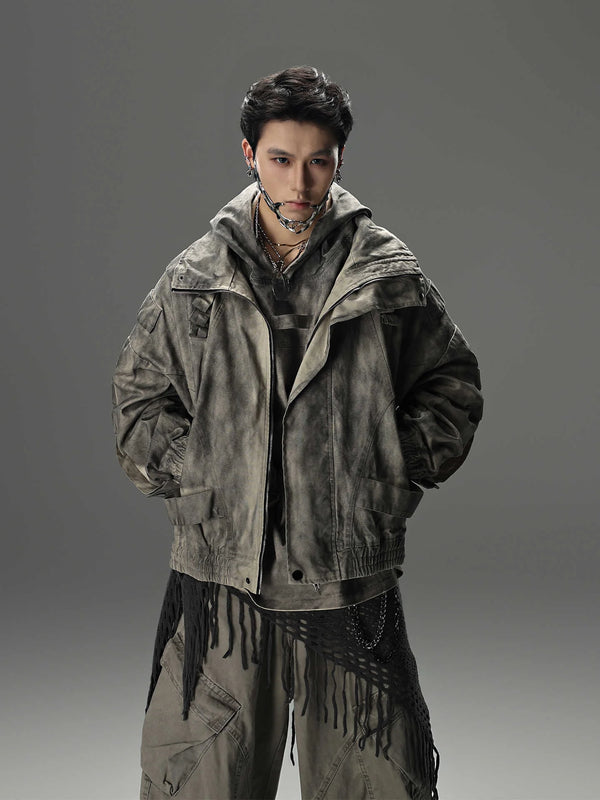
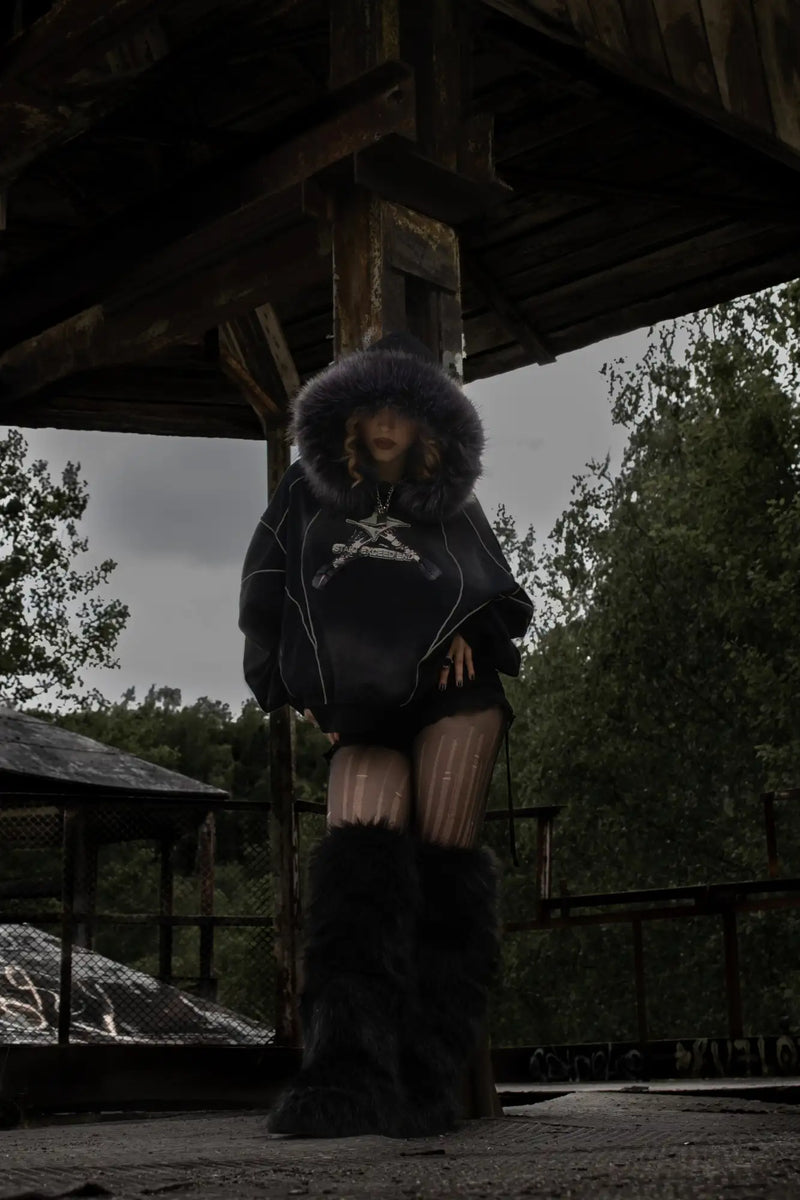
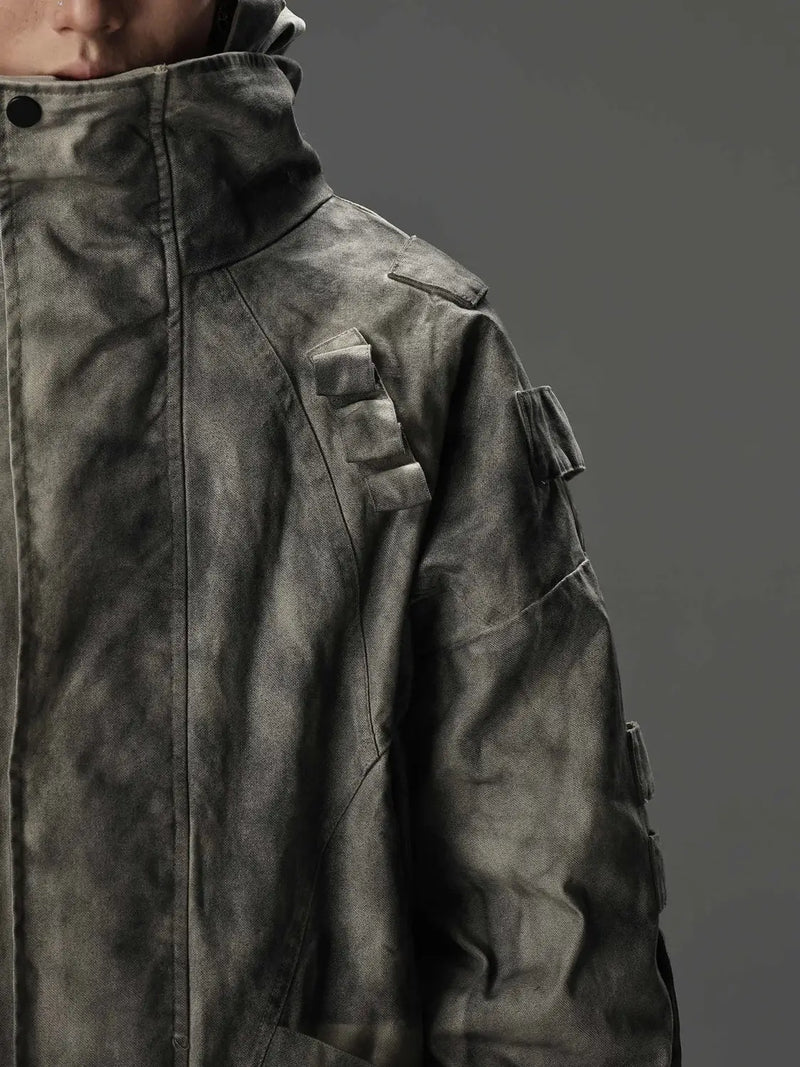
Slot 3 — Outerwear. Oversized. A leather puffer, a plush leather coat, a studded blazer, a fur-hood puffer. The outerwear piece adds volume upward, not downward — the center of gravity of the look sits in the middle, the pants carry width, the jacket carries mass. Without outerwear the look stays incomplete — the 4-slot plan has no idle mode.
Slot 4 — Accessory anchor. Silver, not gold. A long chain (hanging low, at navel height), a claw ring, wraparound sunglasses, a CT belt with a silver buckle. The anchor is the signature of the outfit — without it the outfit reads as a "dark lookbook attempt" instead of an Opium signature. A single anchor is enough, three are too many.
▸ Quick take: why four slots, not five
Five-slot systems (top + bottom + outerwear + shoes + accessory) are common in minimalism or old-money dressing. Opium collapses shoes and accessory into a single 'anchor slot' with three interchangeable forms — boots OR hardware OR glasses. That keeps the look sharp instead of overloaded. Wear all three anchors at once and you produce Halloween, not Opium.
Silhouette equation: tight on top, wide on the bottom
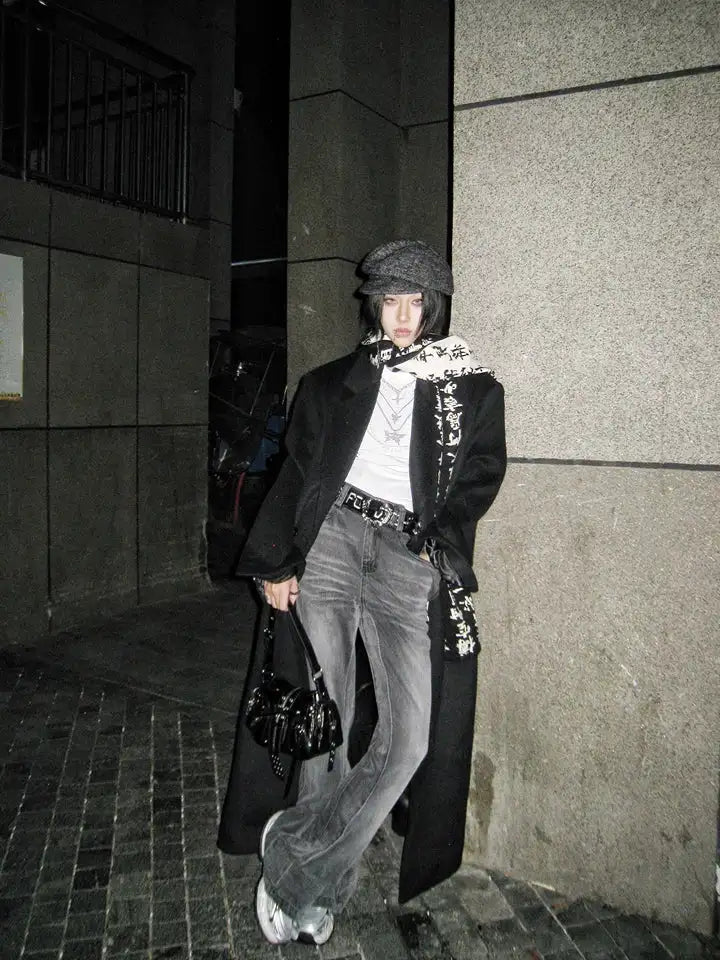
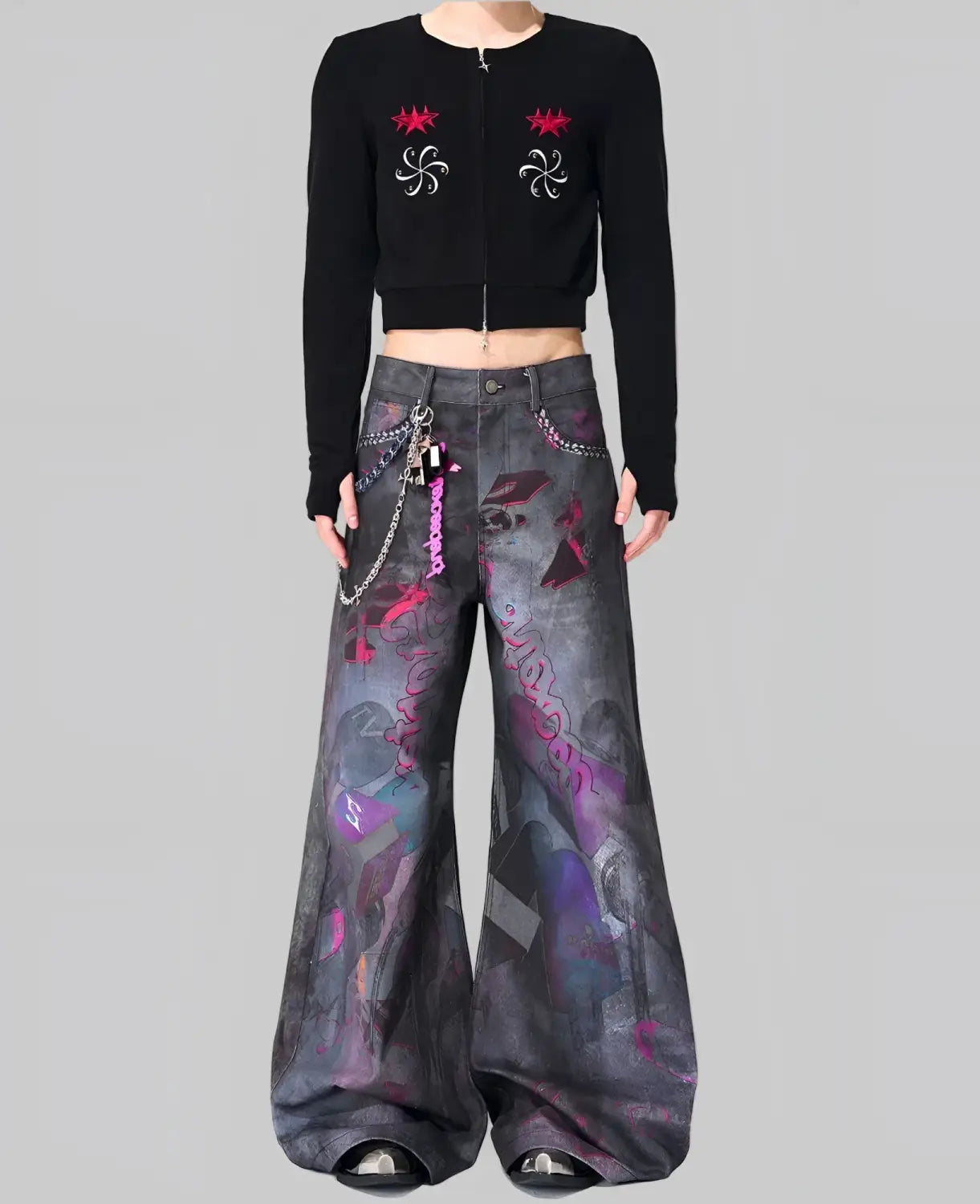
The silhouette equation is the only rule you have to know by heart. The top sits on the body — not skin-tight, but with contact at the chest and the shoulder line. The pants break into volume at the hips and fall wide to the floor. That's it. No other proportions work for Opium.
Why this equation? Because it splits the body into two clear zones: sharp on top, sculptural below. The contrast between a tight upper and a wide lower silhouette creates the drape that rappers like Carti or Ken Carson wear on stage — without it looking like a costume. The equation makes Opium unmistakable, because almost every other aesthetic wears one of the three remaining silhouette combinations.
Wide on top, tight on the bottom reads as 2000s hip-hop or as an MTV poser — Ken Carson explicitly does not wear that. Both tight reads as Goth or Preppy — far too courtly for Opium. Both wide reads as skate Streetwear or gorpcore sack — formless, not sculptural. Only the combination tight on top, wide on the bottom produces the Opium silhouette, because it exposes the shoulder line and carries the volume downward.
The benchmark is the chest. When you put your top on and run a flat hand across the chest, three fingers should fit between fabric and skin — no more. The top is then fitted without being skin-tight. The pants start at the hips and from the thigh down carry at least 30 centimeters of volume per side — measured at the widest point of the pant leg.
| Silhouette combination | Signal | Aesthetic mapping | Opium verdict |
|---|---|---|---|
| Tight on top · wide on the bottom | Sculptural contrast, shoulder line bare | Carti-Opium, Rage-Opium | ✓ Opium-Core |
| Wide on top · tight on the bottom | Top falls over the hips, pants skinny | 2000s hip-hop, MTV poser | ✗ Not Opium |
| Both tight | Fitted all over, no volume zone | Goth, Preppy, Skinny-Rock | ✗ Not Opium |
| Both wide | Sack silhouette, no clear contrast | Skate-Streetwear, Gorpcore, Lounge | ✗ Not Opium |
💡 Pro tip: the three-finger rule for the top
Put the top on. Run a flat hand across the chest. If three fingers fit between fabric and skin, the fit is right. If five fit — too wide. If the hand won't fit underneath — too tight. Three fingers is the only measurement you have to remember: anything else tips the Opium silhouette equation into Gothic (too tight) or Streetwear (too wide).
Four Opium outfit archetypes — to style directly
The slot formula and the silhouette equation allow hundreds of outfits on paper. In practice four archetypes exist that show up repeatedly in the Carti ecosystem and in Fūga looks. Each archetype is a concrete configuration of the four slots, not a vibe description. You can rebuild them 1:1 or swap a single slot, as long as the silhouette equation holds.
Archetype 1 — Carti Classic
Slot 1: tank or T-shirt with embroidery — body-close, no logo, no graphic chaos. Slot 2: wide-leg jeans, heavy distressed, dark wash. Slot 3: leather puffer in black or brown. Slot 4: silver chain hanging low, plus wraparound glasses. This is the signature fit of the Whole Lotta Red era — timeless in Carti terms, because the silhouette equation holds perfectly and the accessory anchor sits on its own instead of stacking.
Archetype 2 — Stage-Night Opium
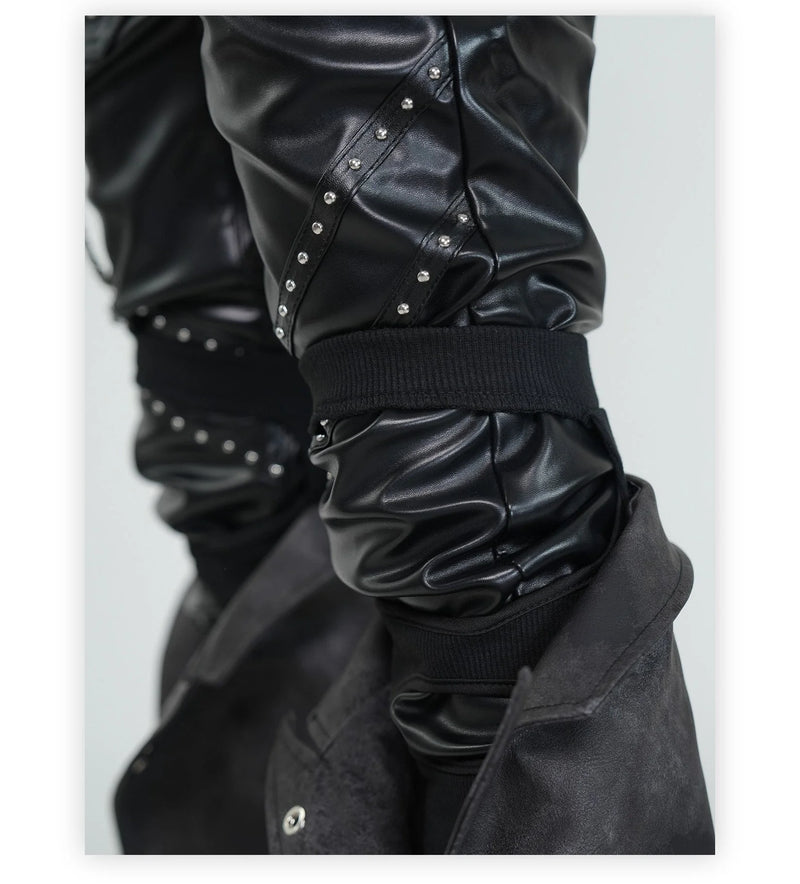
Slot 1: black mesh longsleeve, alternatively a sheer shirt with light texture. Slot 2: leather pants in a boot cut, NOT skinny leather. Slot 3: studded blazer or plush leather coat with a glossy surface. Slot 4: claw ring or a CT belt with a silver buckle. The configuration is the performative variant — it carries more shine, because stage light shapes the look hard. The mesh longsleeve replaces the tank because it delivers more texture for the camera without breaking the silhouette equation.
Archetype 3 — Street-Utility Opium
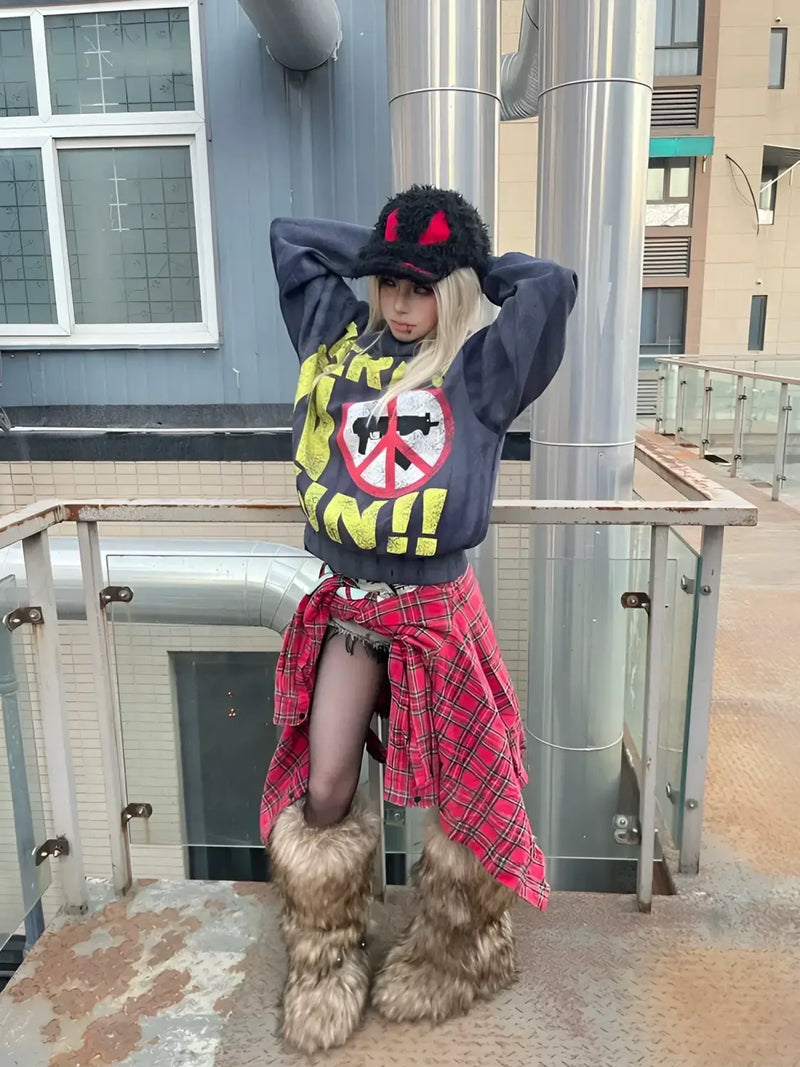
Slot 1: graphic hoodie with a specific dark print (anatomical, spine, devil-horn) — no generic wordmark. Slot 2: cargo pants with multipocket, gradient wash accepted. Slot 3: oversized leather jacket with a zipper detail, alternatively a windbreaker with mesh inserts. Slot 4: combat boots plus a single silver chain. This archetype carries functionality visibly — the cargo is Opium-capable as long as the silhouette stays wide and the hoodie stays cropped or at least hip-short.
Archetype 4 — Cargo-Apocalypse Opium
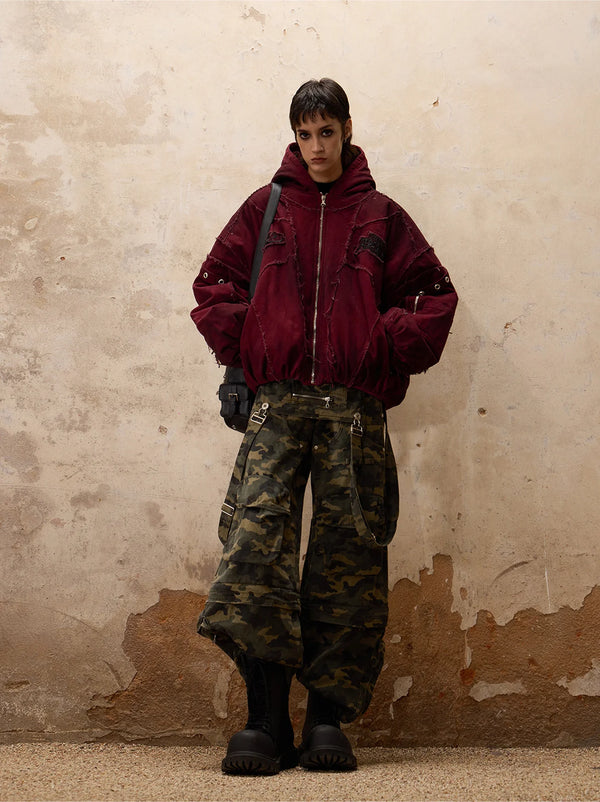
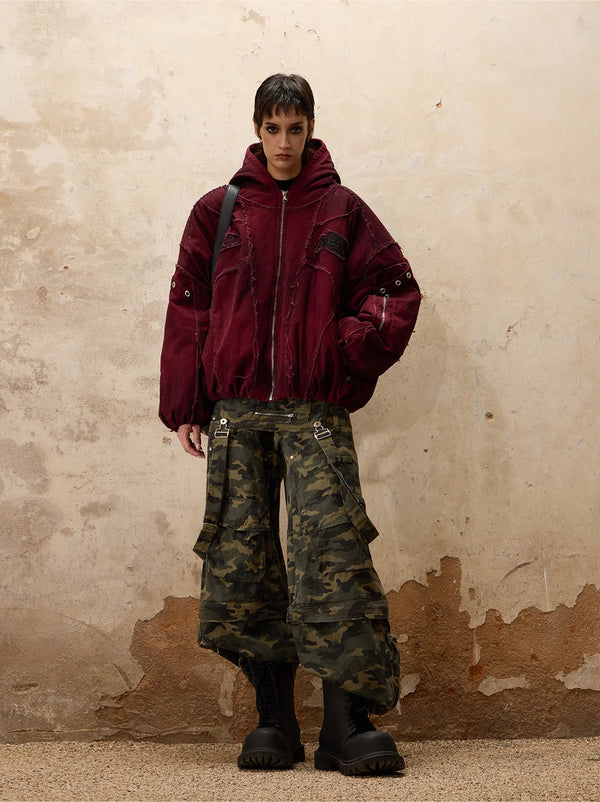
Slot 1: black mesh tank, alternatively a spine-embroidery shirt. Slot 2: distressed wide-leg jeans or gradient cargo with a dirt wash. Slot 3: leather coat in brown or black, plush surface, fur hood allowed. Slot 4: leather harness over the pants, silver stirrup buckles, boots. The most extreme of the four configurations — it adds a harness as a second accessory layer but stays correct on paper, because harness and buckles count as a single anchor complex (all silver, all hardware). Works only in cool weather and in contexts where a post-apocalyptic signal is wanted — at a party in a karaoke bar, rather not.
🛒 The building blocks for every archetype
Three collection spots — each calibrated to one slot anchor
Shoes, hardware, sunglasses — the finisher grammar
The finishers are the Slot 4 anchor in its spelled-out form. Three categories, three rules — each category has a hard grammar that carries the look or tips it.
Boots, not sneakers. Opium wears boots, not Dunks and not Jordans. The permissible silhouettes are combat boots (lug sole, flat last), moto boots (with a strap detail or a zipper on the inner side), and platform boots (1–3 cm plate, not the 8 cm tall-goth plate). Sneakers signal Streetwear — and although there is contact between Opium and Streetwear, a look drops into the Streetwear drawer the moment sneakers are on the ground. The only accepted in-between is a black derby-style shoe silhouette with a chunky sole.
Hardware in silver. Gold is taboo in Opium — not out of color philosophy, but because gold signals rapper jewelry, and Opium is explicitly not rapper-jewelry culture. The silver cut includes: long chains (hanging low, navel height), claw rings (usually several on one hand), CT buckle belts, small ear cuffs. A single hardware spot is enough for an outfit. Two is the maximum, if both are assigned to the same body spot (chain and ring are both 'body hardware'). Three spots turn the look into Glamoratti or Vamp Romantic.
Sunglasses as a structural element. The Opium glasses are the wraparound or the shield silhouette — they close the look because they bring the face into a clear graphic shape. Pilot glasses read as old-money or aviator cosplay, round glasses as poetcore or intellectual dark academia. Only the wraparound and the shield silhouette are calibrated for Opium. Don't necessarily wear them all the time — but if the glasses are part of the look, the silhouette has to be right.
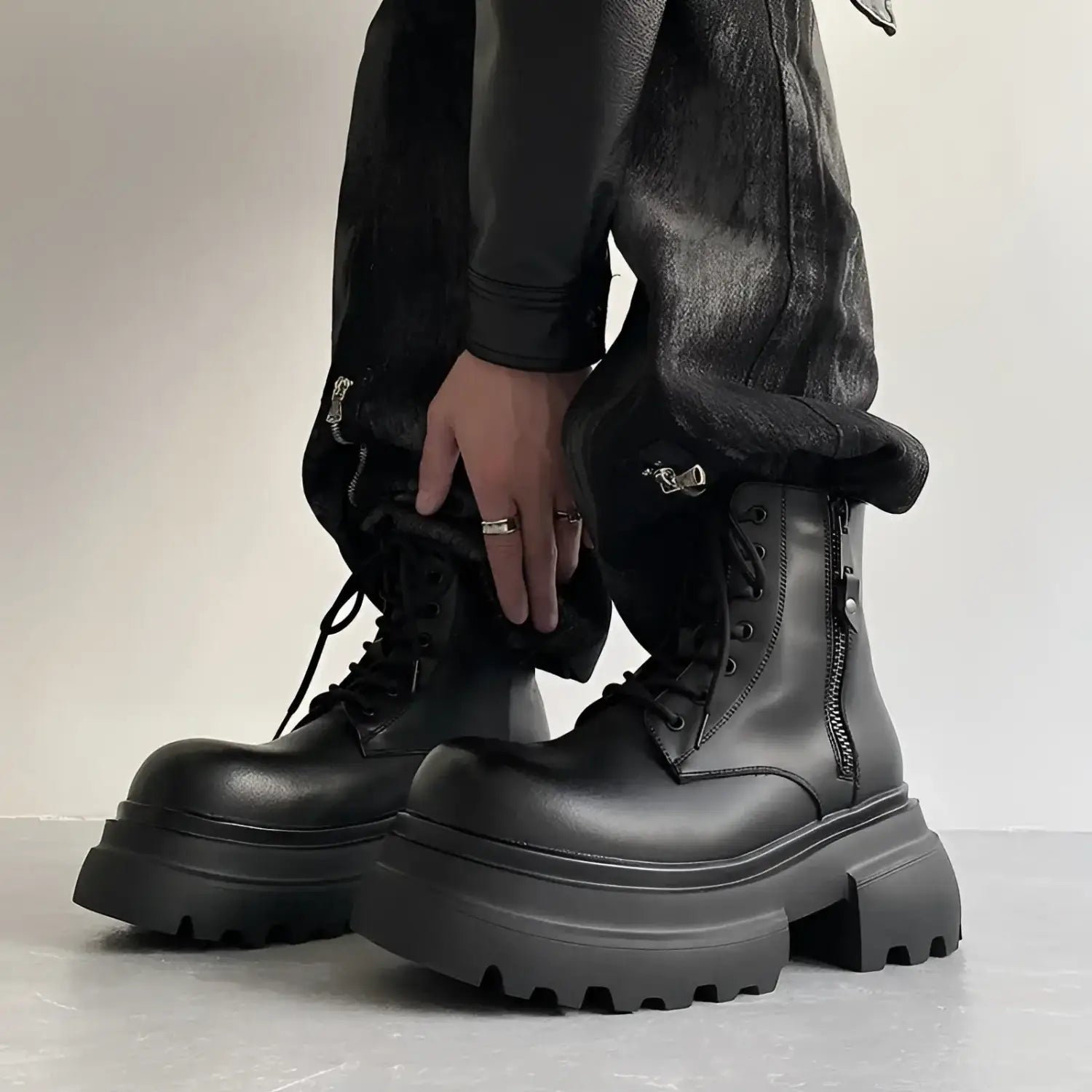
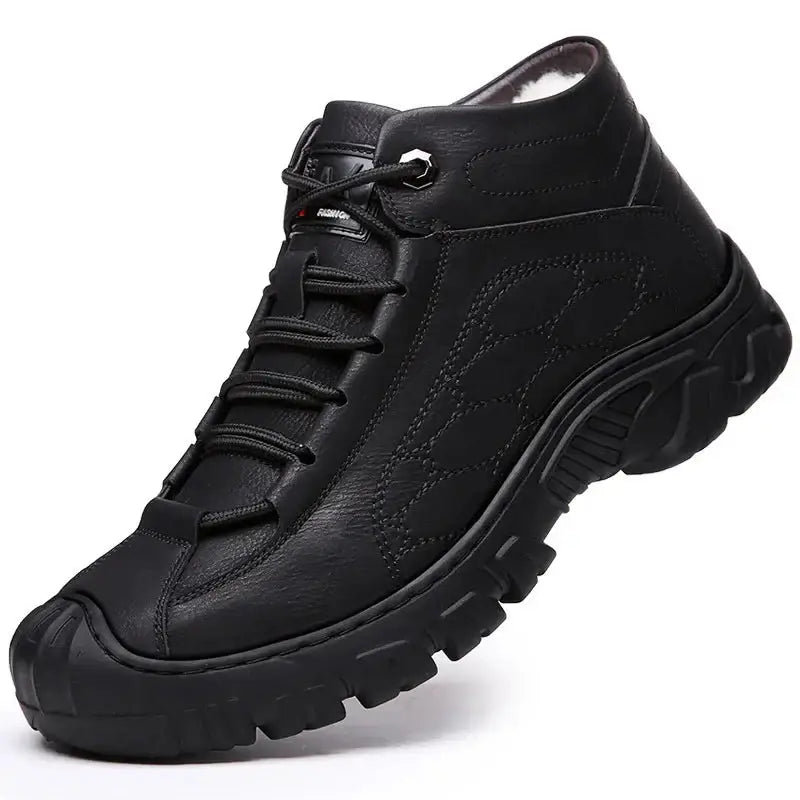
What happens when one of these three grammar rules tips? The look doesn't break dramatically — it just slides into another aesthetic drawer. Gold instead of silver, and the outfit reads as rapper Streetwear. Sneakers instead of boots, and it reads as Dunk-Low casual. Pilot glasses instead of wraparound, and it reads as a boho-vintage attempt.
That's why it pays to look at the six most common break points in the overall look — not as a list of bans, but as a slide diagnosis. Each point is a concrete signal at which Opium separates from its nearest aesthetic neighborhood.
Six break points where the Opium look collapses
These six fails are not a matter of stylistic opinion, but signal slide. Each one shifts the look into a neighboring aesthetic — none of them is 'bad', but none of them is Opium. In front of the mirror it pays to run through the list in three-second mode: tip one of them, and the whole fit tips.
🎯 6 Opium break points — the signal-slide check
- Chain is gold instead of silver → signal slides to rapper jewelry and hip-hop Streetwear
- Sneakers instead of boots on the ground → signal slides to Dunk-casual or skate Streetwear
- Skinny jeans instead of wide-leg → signal slides to 2010s Emo or Modern-Rock
- Top falls loose over the hips → silhouette equation tips, signal slides to Grunge or oversize Streetwear
- Color tone over 10 percent of the outfit (bright color, pastel, neon) → signal slides to Y2K or Rave
- Logo large and legible on the statement piece → signal slides to luxury Streetwear or Logocore
The most common fail in practice is point 1 — the gold chain. It's already sitting in most jewelry boxes, the temptation is maximal, the slide is instant. The second most common is point 5 — the accidental color tone, usually a sneaker with a white or colored detail, a sock flashing under the pants, a lace in red. The 10-percent cap is hard: more than a narrow colored accent is enough to break the monochrome code.
Point 6 — the visible logo — is the trickiest, because many good Opium-adjacent Pieces carry a large trademark. The rule is simple: a logo caught by the eye in ≤ 2 seconds is an anchor and ruins the fit. Anatomical embroidery, spine prints, abstract wordmarks in small type are OK — they read as graphic, not as a trademark.
💡 Pro tip: the silver-hardware test
Lay all the hardware pieces of your outfit side by side on the table. Ring, chain, buckle, ear jewelry. Are they all in a silver tone (chrome, matte silver, aged silver, gunmetal)? Pass. If a gold piece, rose gold or brass tone shows up — set it aside and find a silver replacement. This test costs 30 seconds and saves the look from the most common Opium fail.
The order of the checks in front of the mirror is decisive. First the silhouette equation (tight on top, wide on the bottom — three fingers at the chest, 30 cm of volume at the pant leg). Then the silver test for all hardware. Then the color-tone cap — if a tone flashes somewhere that isn't black, gray, brown or white, check whether it stays under the 10 percent or gets cut.
What remains are the context decisions. An outfit that works in the karaoke bar is often too soft for a concert. A fit that works on stage is mostly too performative for everyday life. Opium scales, but the Slot 4 anchor swaps between contexts: everyday mostly carries glasses or a chain, stage carries hardware and a harness, everyday-upgrade carries boots instead of a derby.
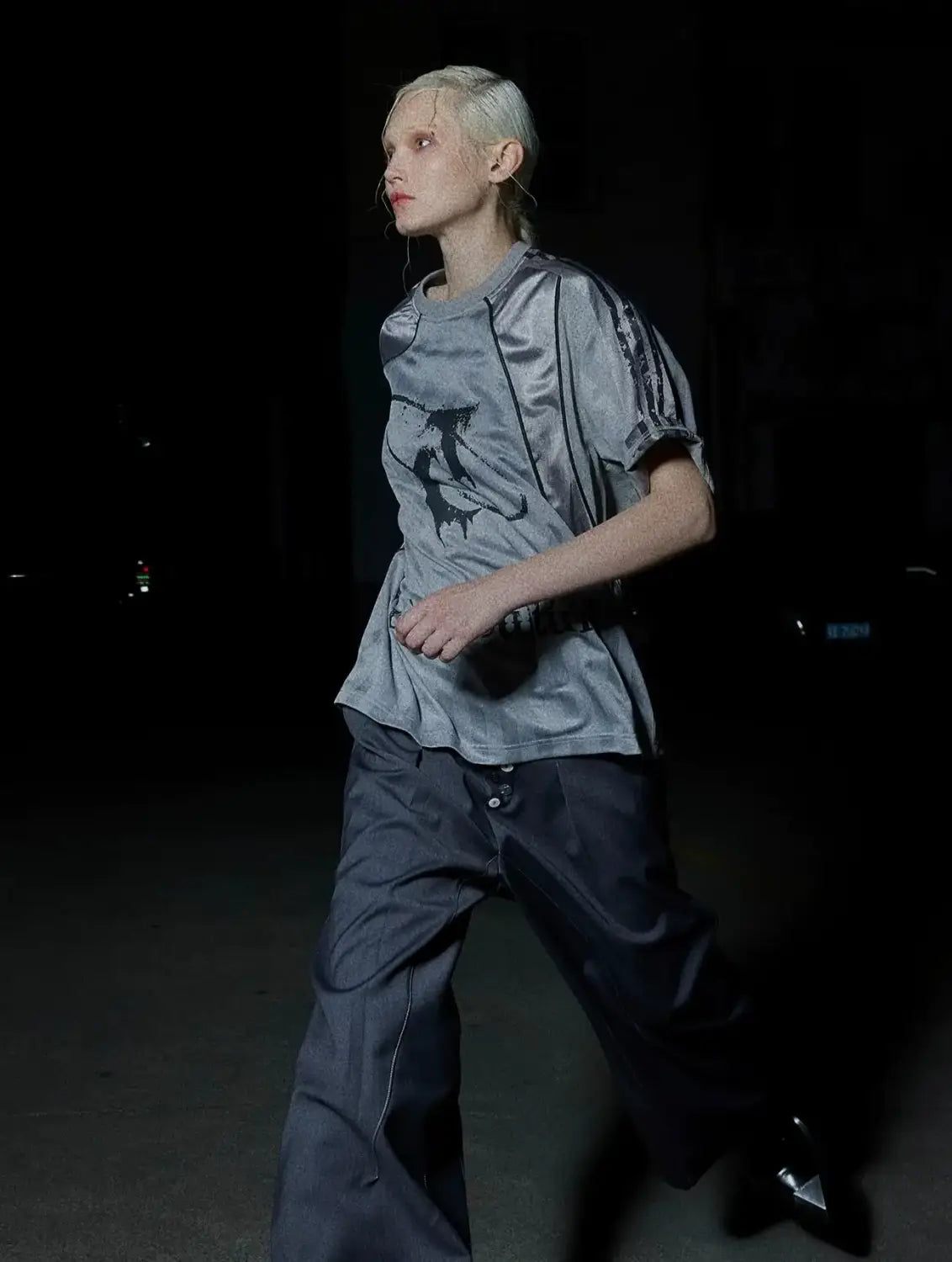
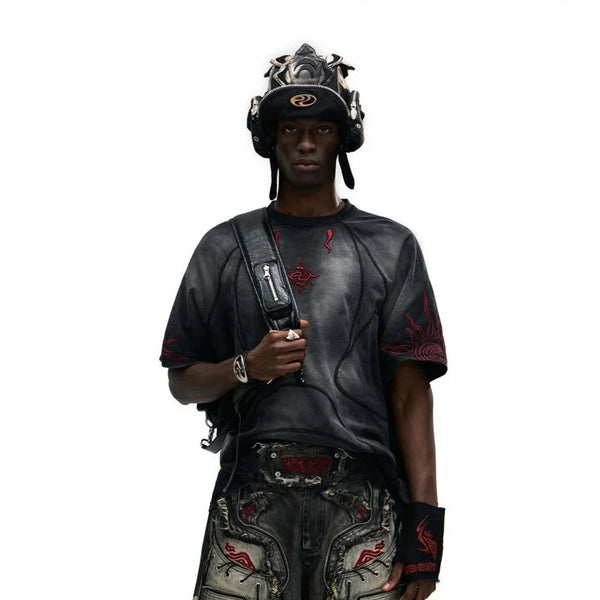
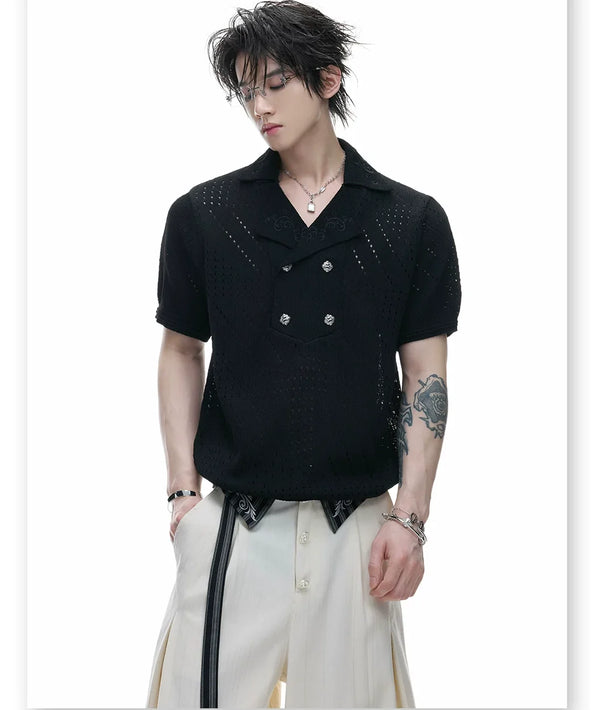
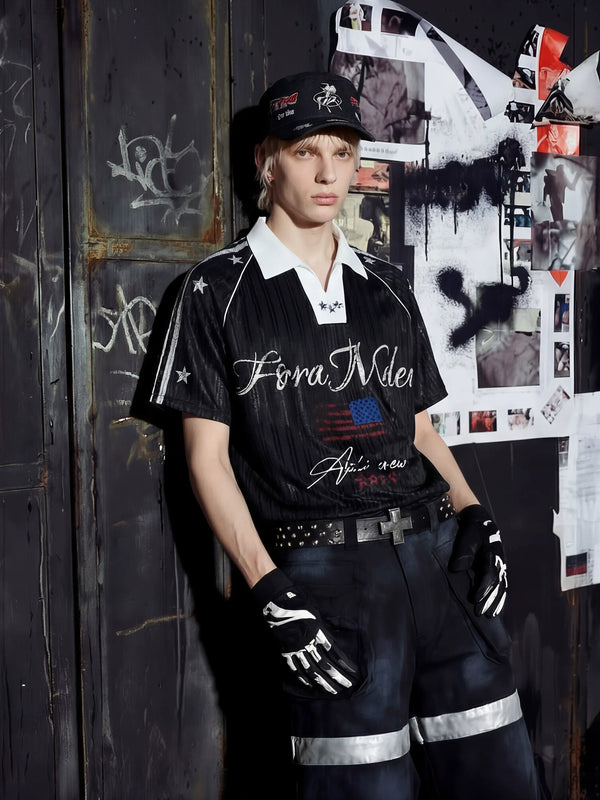
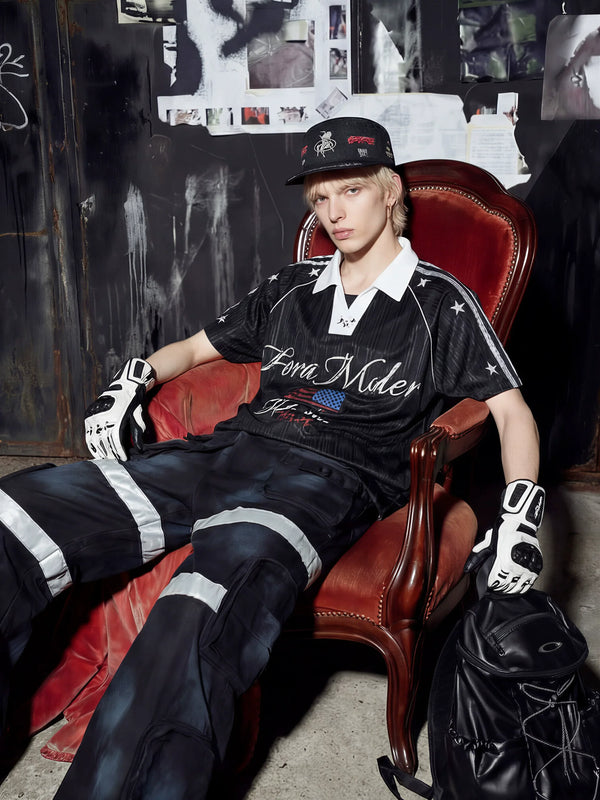
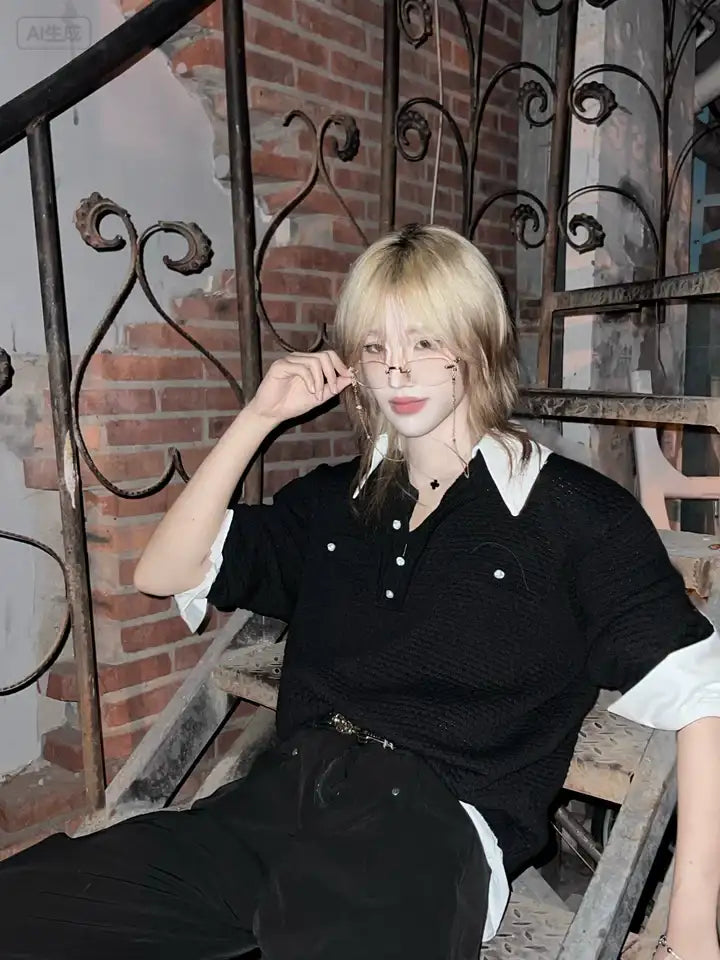
The look above shows the silhouette equation in its purest form: a graphic jersey top that sits on the body, over silk wide-leg pants that carry volume from the hips down. No logo, no loud accent, a single silver ring as the accessory anchor. The entire construction works with the same 4-slot calculation you can reproduce in your own wardrobe.
The question remains where your slot anchors come from. The Fūga Opium family covers the four slots — tops, pants, outerwear, hardware accessories — with Pieces whose silhouettes are calibrated to the equation. You don't have to buy everything at once. Start with the slot that's weakest in your wardrobe — most of the time that's the wide-leg pant or the leather outerwear piece.
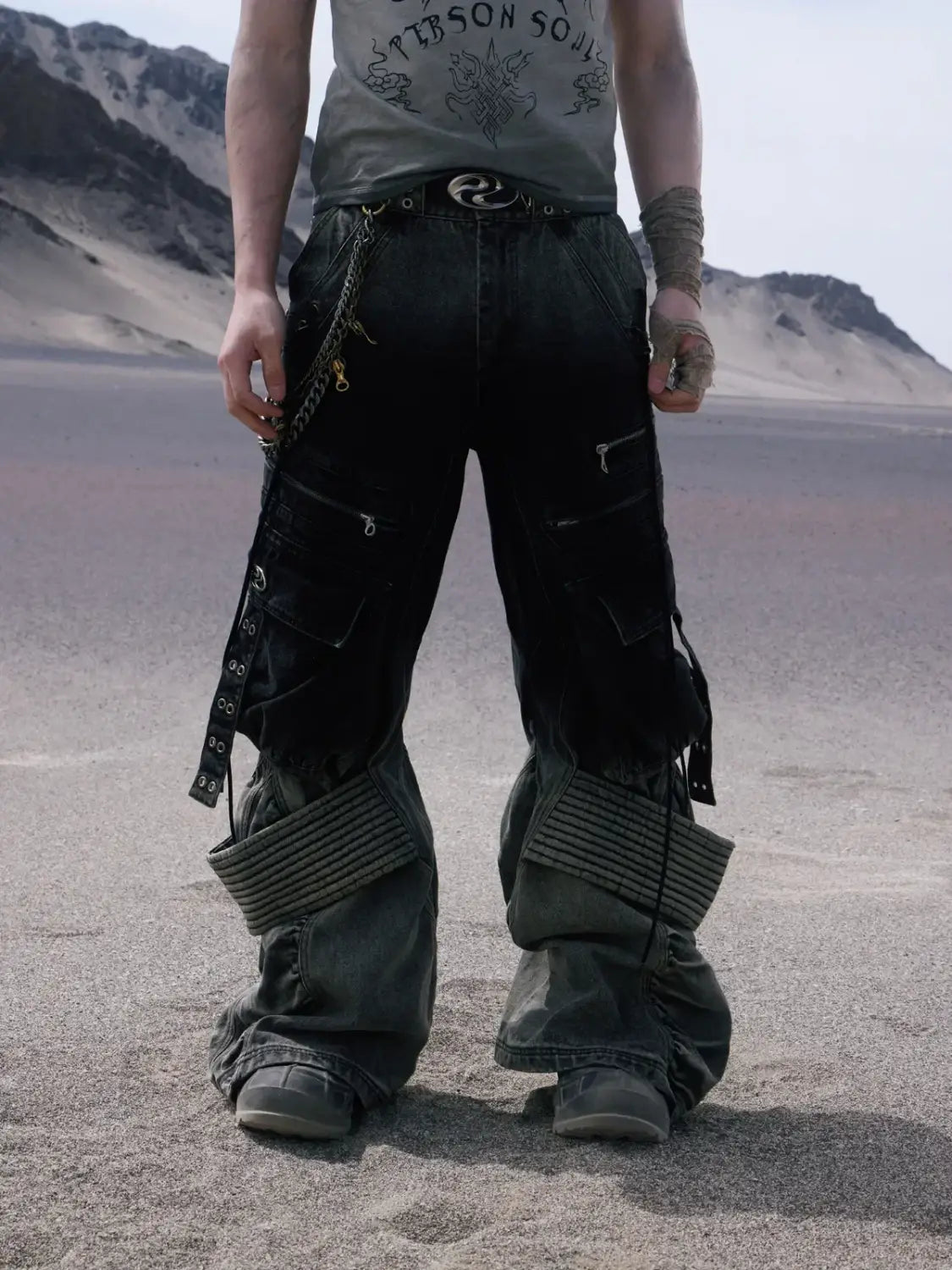
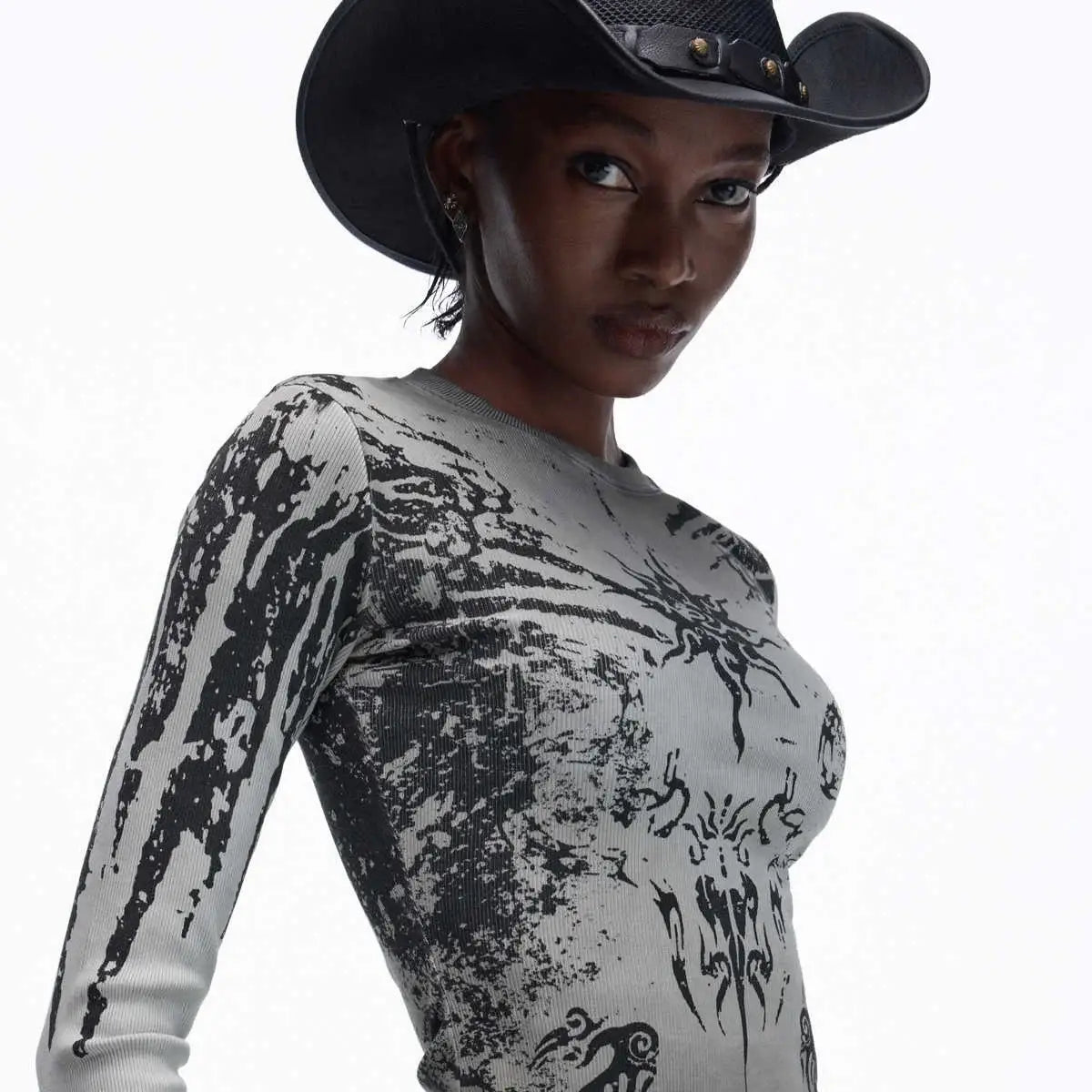
One last check before the fit goes into the photo: the three-second mirror rule. You stand in front of the mirror, close your eyes for three seconds, open them, and look at the outfit as if it were on a stranger's body. Does it read as an Opium silhouette immediately? Then it fits. Do you see the brand, the logo, the gold chain, the sneaker first? Then the look slides into another aesthetic — back to the checklist.
The tone and the movement deliver the rest. Opium isn't worn statically — the pants flow, the chain swings, the shoulder line is deliberately bare. Carti and Ken Carson show exactly this movement in their clips, not just the stills. The outfit is less costume, more costume design for walking.
🎥 Opium in motion: a silhouette that breathes
@fugastudios elevate your wardrobe to shadowy sophistication — opiumcore trend arrival
Follow us on TikTok for more style inspiration! 🖤
Verdict: Opium calculates, doesn't improvise
Verdict: four slots, two silhouettes, one clear check
Opium doesn't read through expensive brands, but through concrete geometry. The 4-slot formula gives you the blueprint, the silhouette equation gives you the proportion, the finisher grammar gives you the anchor. Whoever keeps these three layers apart and checks each slot on its own builds a fit that belongs in Carti spheres — not in the 'dark look whatever' drawer.
The six break points show where the slide happens. Gold, sneakers, skinny, top-over-hips, color-tone-over-10-percent, visible logo. Each of these six diagnoses costs you three seconds in front of the mirror and saves you from the most common mistake: Opium as costume instead of signature. In the end the look is an equation anyone can rebuild who knows the slots.
Three fingers at the chest, 30 centimeters of volume at the pant leg, silver instead of gold — that's the complete formula.
Ready for the next Opium fit?
You'll find the building blocks for all four slots in the Opium collection — pants, outerwear, hardware, boots.
🖤 Zur Opium-KollektionFree shipping from €169 | 14-day returns
The Fūga universe
Opium is one of six Fūga aesthetics
Each aesthetic solves its own silhouette equation — Opium is the version for sharp contrast and a silver anchor.
Frequently asked questions about dressing Opium
Frequently asked questions about dressing Opium
What is the 3-3-3 rule in Opium styling?
Three slots are mandatory (top, bottom, outerwear), three fingers between top fabric and chest, three Opium signals in the look (silver hardware, wide silhouette below, boots). Fewer than three signals doesn't read as Opium, more than five tips into costume. The rule is a memory aid, not a law — as long as the silhouette equation and the silver cut hold, you can vary one slot.
Which pant silhouette is 'Opium fit'?
Wide-leg jeans, cargo pants with a multipocket detail, leather pants in a boot cut, or silk wide-leg. The pants start at hip height and from the thigh down carry at least 30 centimeters of volume per side at the widest point. Skinny jeans, slim-tapered chinos and jogging pants with a cuff at the ankle are not Opium — they tip the silhouette equation and read as Streetwear or rap casual.
Which shoes do Opium looks wear?
Combat boots, moto boots with a zipper detail, platform boots with a flat 1-3 cm platform, or a dark chunky-sole derby as an in-between. Sneakers are not Opium — even dark Dunks, Yeezys or Jordans read as Streetwear, not as Opium. The boot silhouette is part of the vertical line: a wide pant hem breaks over a massive boot shaft, that's the signature.
Why does Gen Z wear such wide pants — even outside Opium?
The wide-leg silhouette established itself as a counter-movement to the skinny-jeans era (2005-2018) and shows up in many aesthetics — Y2K revival, Techwear, Grunge, Opium. Within Opium, though, it isn't free to choose, it's mandatory: Opium works with volume below as a contrast to the tight upper silhouette. Wear wide-leg without the tight top anchor and you land in Streetwear or Techwear, not in Opium.
Does Opium styling work for female-read bodies?
Yes, the 4-slot formula and the silhouette equation are body-independent. Fitted top + wide-leg bottom + oversized outerwear + silver anchor works in all body readings. What changes is the choice in the top slot: a mesh longsleeve, a corset top, a cropped tank or a sheer shirt. The Fūga Opium tops selection covers these variants without breaking the silhouette equation.
How much does a complete Opium fit cost?
An entry-level Opium fit (one piece per slot, no premium leather pieces) runs around 250-400 euros — top ~40-60, wide-leg pant ~80-120, outerwear ~120-200, silver chain ~20-40. A fully kitted version with a leather puffer, leather pants and harness accessories comes to 800-1200 euros. The slots can also be built up in several stages — the wide pant first, then the outerwear piece, then the hardware.
What do you think?
Tell us on @fuga_studios
About the author
Philipp Fuge — Founder · Berlin
Founder of Fūga Studios. Writes the journal himself. Berlin · Shanghai · Tokyo · Poznań — four cities, one logic.