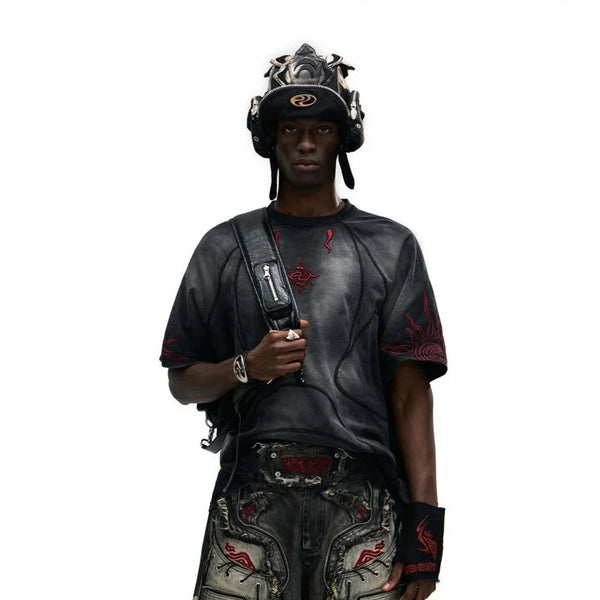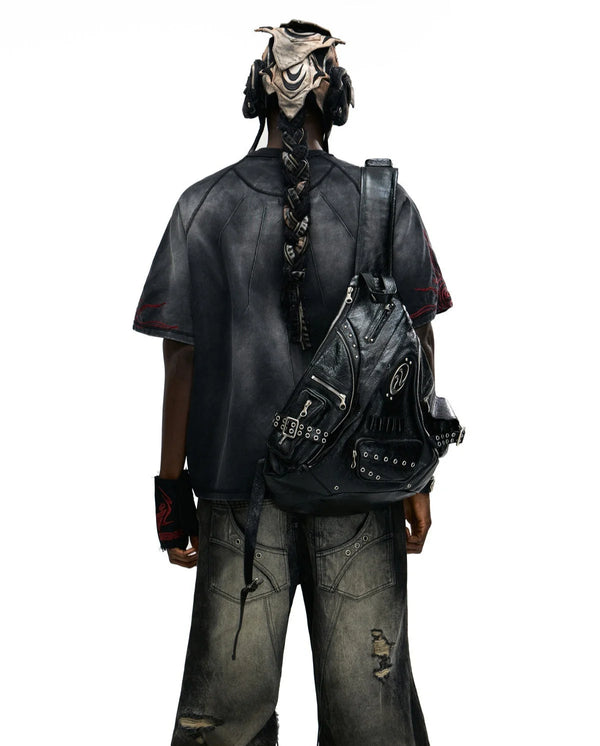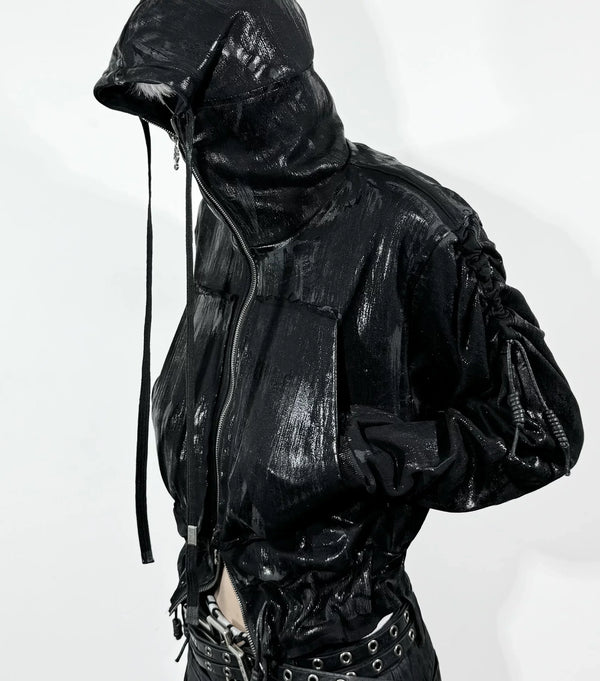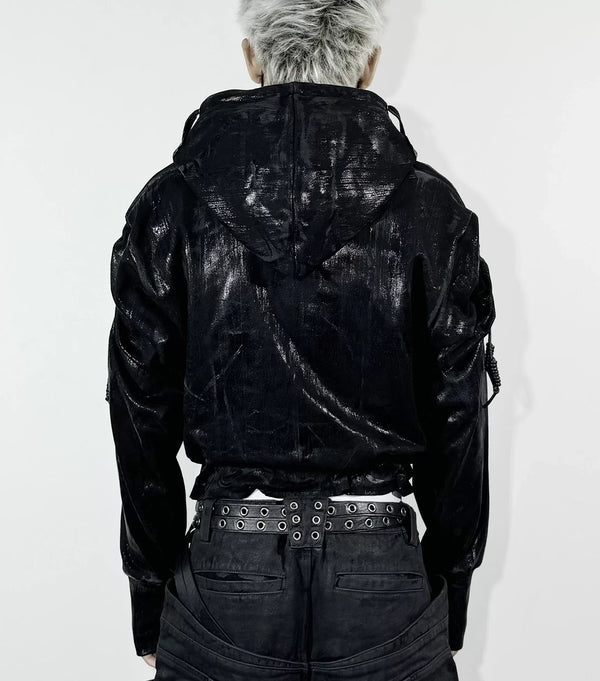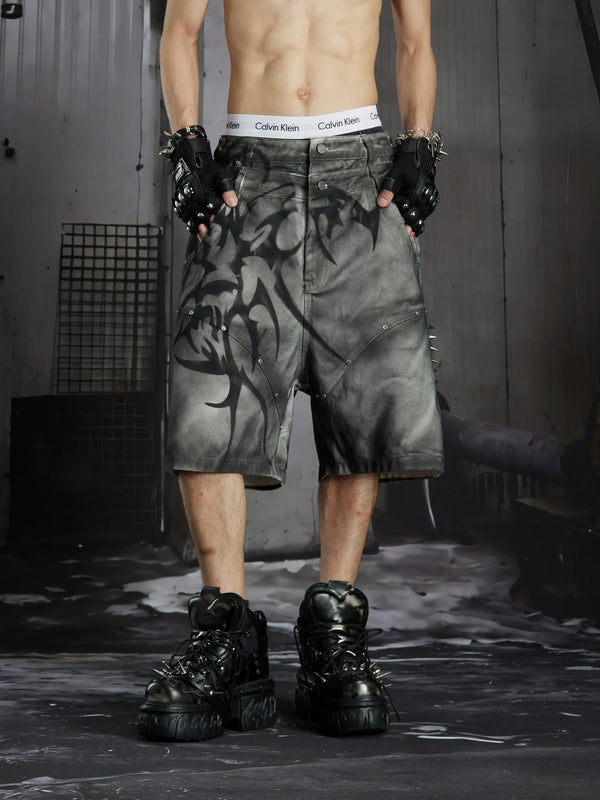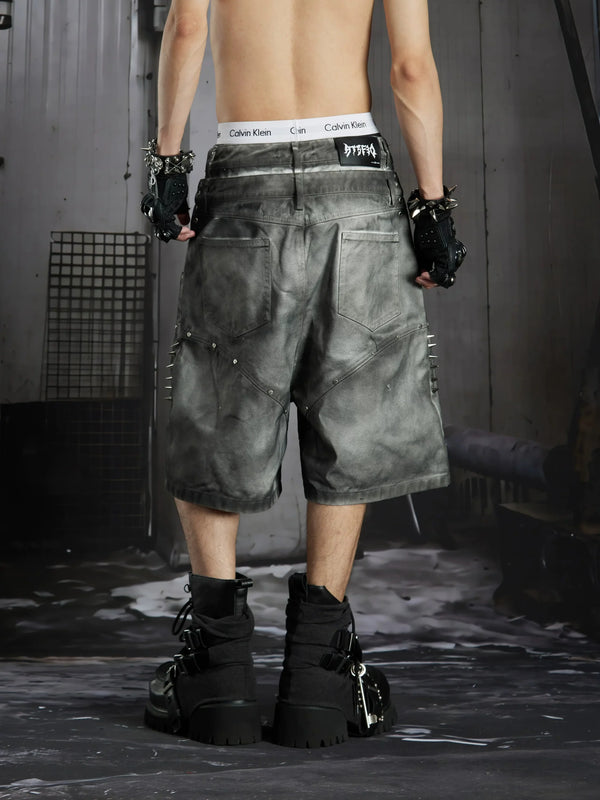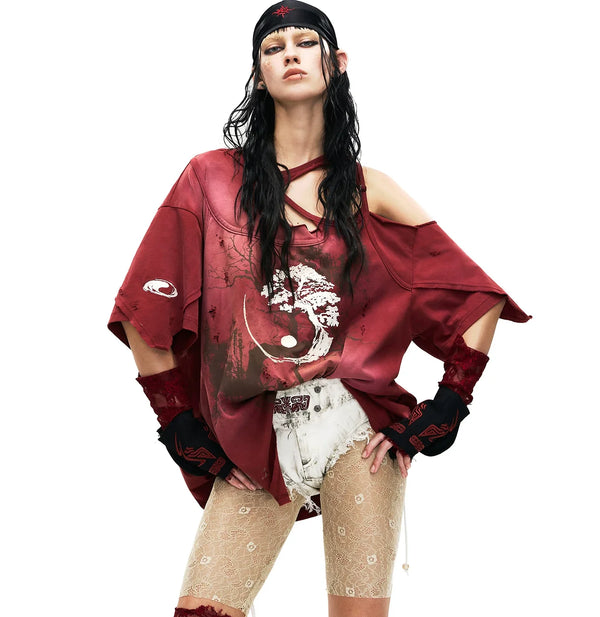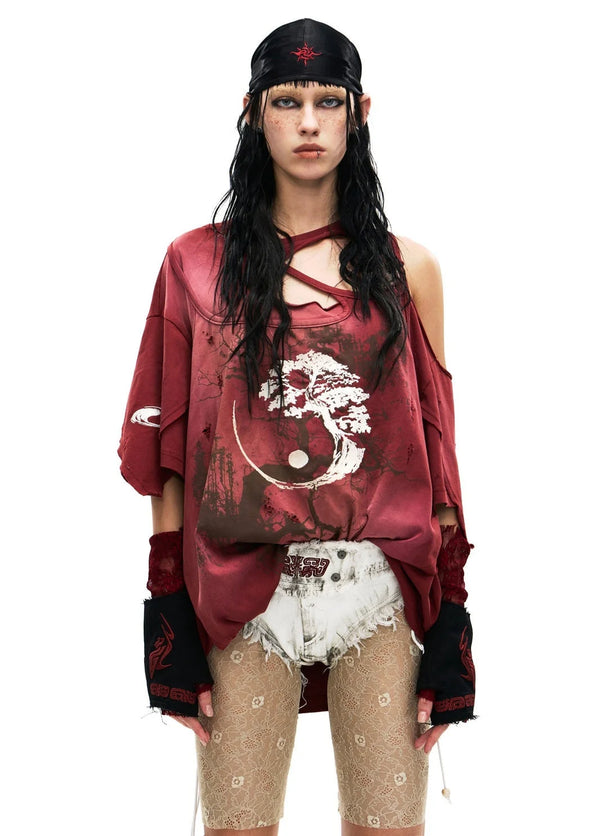
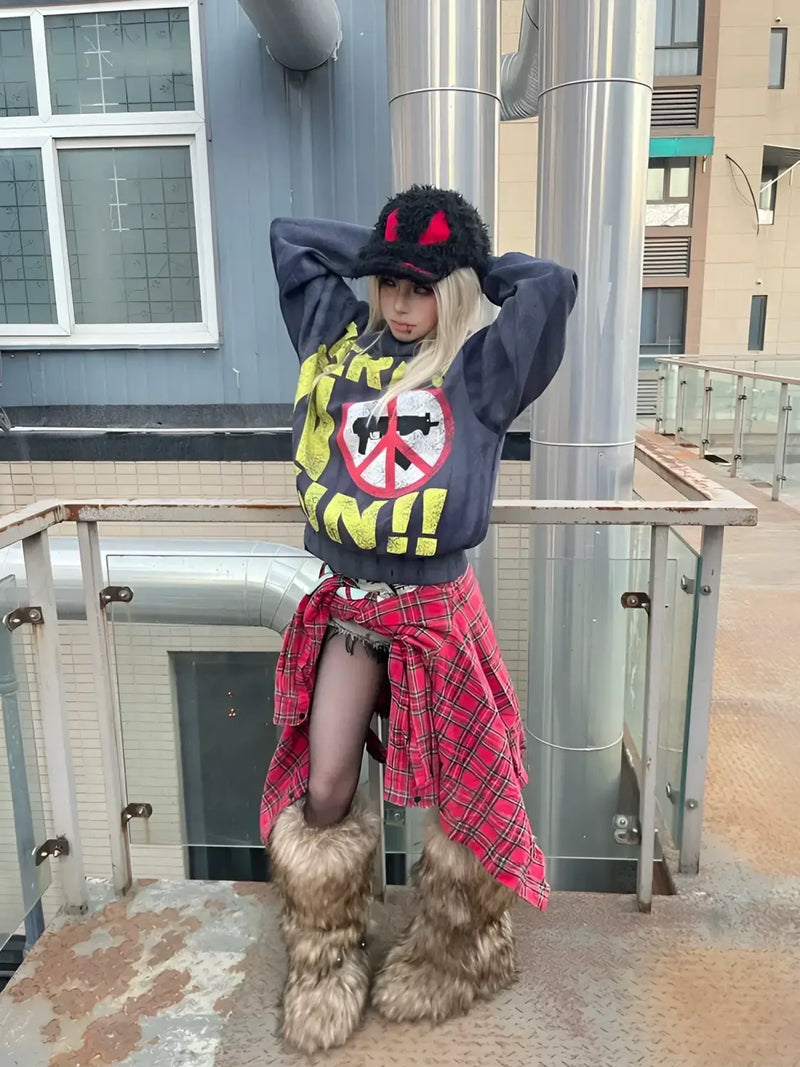
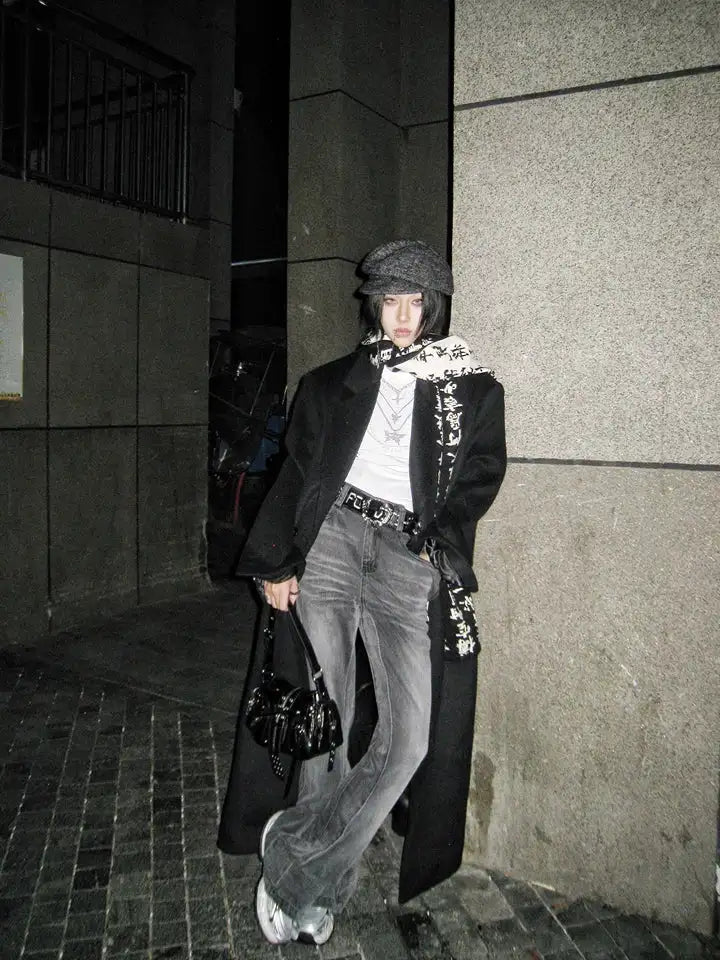

Most people look at a Cyber Goth outfit and see Halloween with a neon mane. That's the story every mainstream paper runs — and exactly why it's never right. Cyber Goth has been a precisely built club-clothing system since the late 90s, not a costume setting.
It's the only Goth iteration that grew out of the dancefloor. Industrial clubs in Leipzig, EBM parties in Berlin, J-Cyber halls in Tokyo, hardstyle festivals in Holland — that's everywhere Cyber Goth became what it is today: an outfit vocabulary for long nights under UV light, with a black base layer, a single loud accent colour and shoes you can wear for twelve hours.
Anyone explaining it as "Goth plus neon legs" hasn't understood the code. This guide breaks it open: where the aesthetic comes from, what the five building blocks are, how the archetypes differ, what men and women wear differently, which brands write the vocabulary, how it translates into jackets / pants / tops / shoes, what hair and make-up add, where you actually wear it — and which six mistakes tip the look in two minutes.
Here's what that looks like in motion, before we take it apart:
Origin
What actually is Cyber Goth — and how did it end up in the rave club?
Cyber Goth isn't a Hollywood spin-off. The aesthetic emerged between 1996 and 2002 in European industrial clubs — Slimelight in London, the Wave-Gotik-Treffen in Leipzig from 1992, K17 and Duncker in Berlin, Batcave successors in Vienna. Goths went into EBM sets and had to dance for twelve hours without the outfit falling apart. Long velvet dresses break. Corsets get too tight. So function came in — mesh instead of lace, PVC instead of velvet, platform instead of stiletto.
Something similar happened in parallel in Tokyo: Harajuku Goths met the J-Tech scene and produced J-Cyber — the Asian iteration, far more colour-intense, with Cyberlocks and mini-skirts. Holland's hardstyle festivals (Defqon.1 from 2003) brought the third wave: Cyber Goth with festival volume, more neon, more energy.
The vocabulary itself has older roots. The black latex layer comes from the 80s fetish scene, the UV-reactive fabrics from the early hardcore raves, the platform boots from industrial workwear and the Japanese Visual Kei movement. Cyber Goth compressed all of it into an outfit that works in a black room with strobe and UV light — and brings a daylight shock factor when you still weren't home by 9 in the morning.
Definition
Cyber Goth outfit code — the 5 building blocks nothing works without
Cyber Goth rave outfits don't work off a list of pretty pieces. They work off five fixed building blocks that together form a system. If one is missing, the outfit tips into another iteration — Industrial-Goth without the Cyber part, or Y2K-Rave without the Goth part, or worse: into EDM-tourist with fun glasses.
80 %
black base
1
UV accent colour
12 h
danceable
0
comfortable-footwear argument
The 80-percent ratio isn't arbitrary. It's the difference between Cyber Goth and rave tourist. Anyone showing up with 50 percent neon and 50 percent black looks like a walking strobe. The base stays black, the colour is a dot — usually an accent strand in the hair, a UV-reactive strap detail on the pants, a neon pair of glasses. Nothing more.
Concretely, these five building blocks count as Cyber Goth:
- Black base layer — mesh top, latex leggings, body, catsuit, black tank. Tight to the body, dark, no print. That's the canvas.
- ONE UV-reactive accent colour — neon-pink, acid-green, cyber-blue or toxic-yellow. Only one. Spread across two spots on the body at most (hair plus strap, or glasses plus belt).
- Chrome hardware and industrial accessories — strap-belts with carabiner, wallet-chain, spike-choker, goggle-glasses, studded gloves. Silver/chrome, never gold.
- Platform boots or heavy stomp boots — New Rock, Demonia, Dr. Martens 1490 or higher. Sole thick enough that you can stand for 12 hours without your knees giving out.
- Hair-architecture — Cyberlocks, synthetic falls, half-dreads, half-shave. Hair carries roughly a third of the look; without it the rest looks empty.
If you're missing two or more of these five building blocks, it isn't Cyber Goth. It's inspiration. And one rule holds them all together:
5 types
The 5 Cyber Goth archetypes — from OG 90s to TikTok-Revival
Cyber Goth isn't one look. It's five, split geographically and chronologically. Put photos from Leipzig 1998, Tokyo 2003, Defqon.1 2009 and Berlin 2025 side by side and you see it instantly. Each archetype has its own black ratio, a different accent colour, a different shoe choice, different hair. An outfit can move between two of them, but a clear statement wears one of them fully.
Which one suits you depends less on taste than on the club. EBM-OG works at Berghain, J-Cyber works in Shibuya, Hardstyle-Cyber works on the field in front of the festival mainstage. The next chapter clears up where men's and women's versions split — and where they don't.
Gender split
Cybergoth outfits men vs women — the line shifts
The rules are the same. Black base, one UV colour, chrome hardware, platform, hair-architecture — applies to every body. What shifts is the line and the hardware density. Men mostly wear Cyber Goth flatter and heavier; women mostly slimmer and more visible.
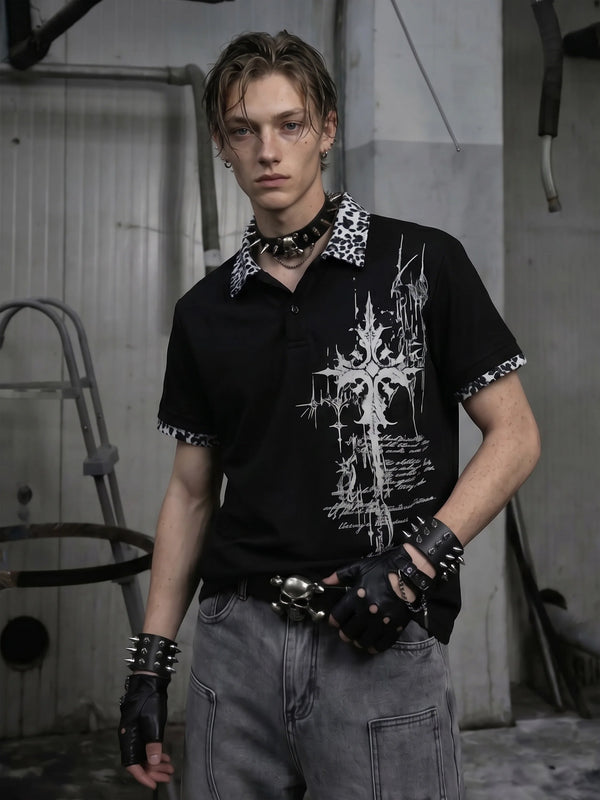
Men's version: cargo pants or wide PVC pants at the bottom, mesh tank or sleeveless shirt on top, plate-carrier vest or strap-harness as a layer, stomp boots or New Rock Reactor. Hair-architecture mostly half-shave plus synth-dread or Cyberlocks at the back of the head. The accent colour typically sits on hardware (goggle-glasses, belt-strap), not in the hair.
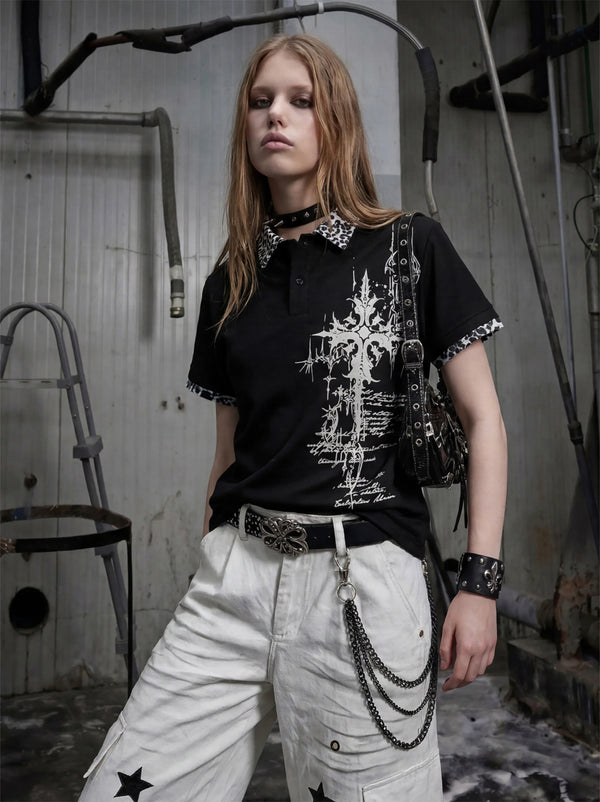
Women's version: mini-skirt or hot-pants over a catsuit layer, or latex leggings under a body. More mesh, more inserts, more skin via layer logic (tight below, transparent on top, solid over it). Platform goes higher — up to 12 cm — mostly New Rock TR or Demonia Trinity. Cyberlocks and falls are standard, often woven through with the accent colour.
Both need the same 80-percent ratio. Where it differs is the distribution: men tend to have more fabric below and more hardware outside, women more hardware up top and more visibility of the base layer. Both versions work when the discipline holds.
Brands
Cyber Goth clothing — where the vocabulary comes from and which brands write it right
The Cyber Goth vocabulary was written between 1998 and 2008 by a handful of brands. Some of them still exist, some have been absorbed into iteration brands, some trade high among vintage hunters. Anyone wanting to wear Cyber Goth either shops these brands or DTC brands that translate the same vocabulary competently.
The eight brands without which there'd be no Cyber Goth vocabulary — roughly chronological:
- Cyberdog — London Camden, since 1994. The movement's central brand. UV-reactive mesh tops, strap-belts, cyber-skirts. To this day the reference point for everything built in the 2000s.
- Demonia — platform boots since the early 90s. Trinity, Stack, Camel, Reactor — every model you see in photos from Berlin and Leipzig clubs comes from this catalogue.
- New Rock — Spanish stomp-boots brand, since 1988. The heavier, harder iteration than Demonia. EBM-OG standard.
- Lip Service — Los Angeles, since the late 80s. Mesh, PVC, strap construction, bondage pants. Shaped American Cyber Goth.
- Tripp NYC — bondage pants, strap-cargo, studded detail. Bridge between punk and cyber, running continuously since the 80s.
- Punk Rave — Chinese iteration, much later (2010s), but by now the best-selling Cyber Goth brand worldwide. Works visually, but it's mass-market.
- Devil Fashion — sister brand of Punk Rave. More industrial, less cyber. Usable for the EBM-OG iteration.
- Fūga Studios — the Berlin-Tokyo line, this one. Translates the vocabulary without the carnival markup. Mesh, latex pants, platform boots, chrome hardware — the categories that have to sit in a modern Cyber Goth wardrobe.
Vintage searching pays off especially for 2000s Cyberdog and early Demonia models (before mass production from 2015). Resale platforms like Depop and Vinted deliver more reliably than eBay, because younger sellers there write shorter descriptions and underestimate original prices.
Category · Outerwear
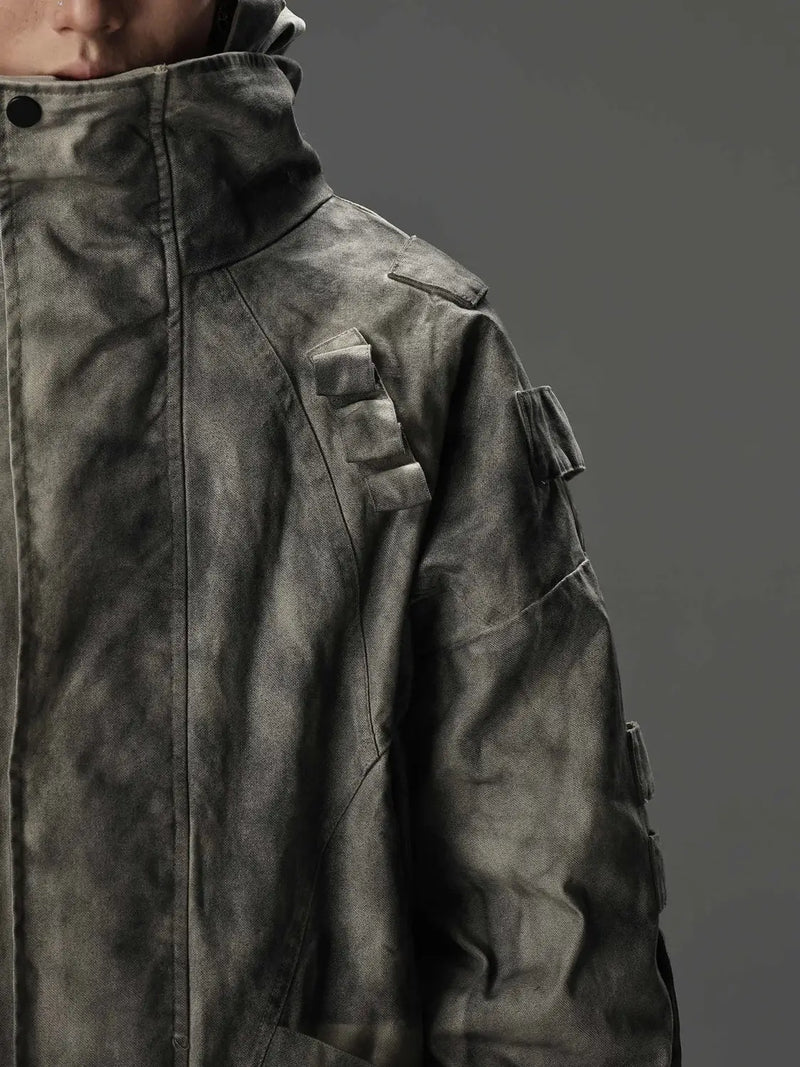
Cyber Goth jackets & outerwear — latex, mesh layer, PVC shell
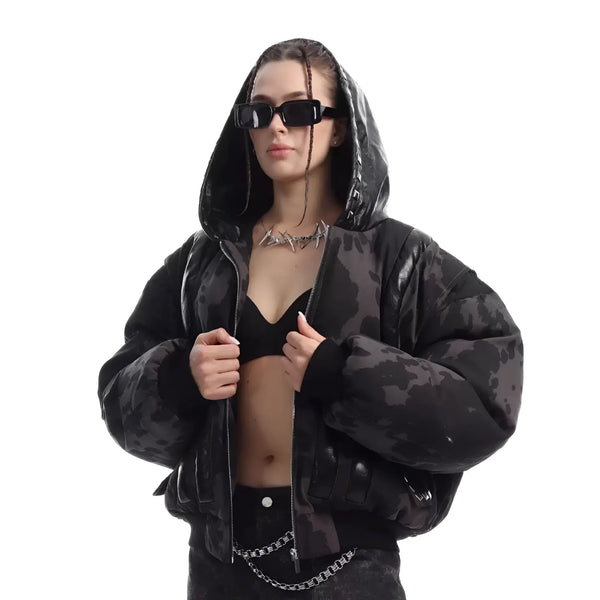
In Cyber Goth the jacket isn't a warmth piece but a layer. It's worn over the body, over the mesh, over the strap-harness — mostly open, sometimes over just one shoulder. It shifts the volume outward and gives the black base an architectural frame.
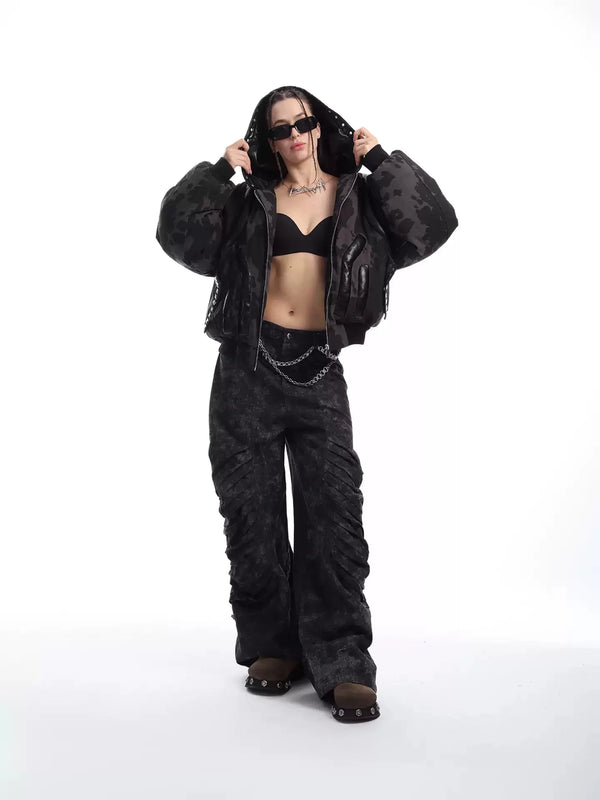
Three jacket types work in Cyber Goth: the short PVC bomber (Hardstyle-Cyber default), the long latex coat or asymmetric trench (Industrial-Goth), and the hooded bomber with chrome accents (TikTok-Revival). Denim jackets come in if they're distressed-black and carry strap detail on the shoulder or hem.
If you don't own any Cyber Goth outerwear yet, start with a hooded bomber. It's the most flexible layer — works over a mesh tank for the club, over a long-sleeve on the way there, and alone over a tank-top in summer.
Category · Bottoms
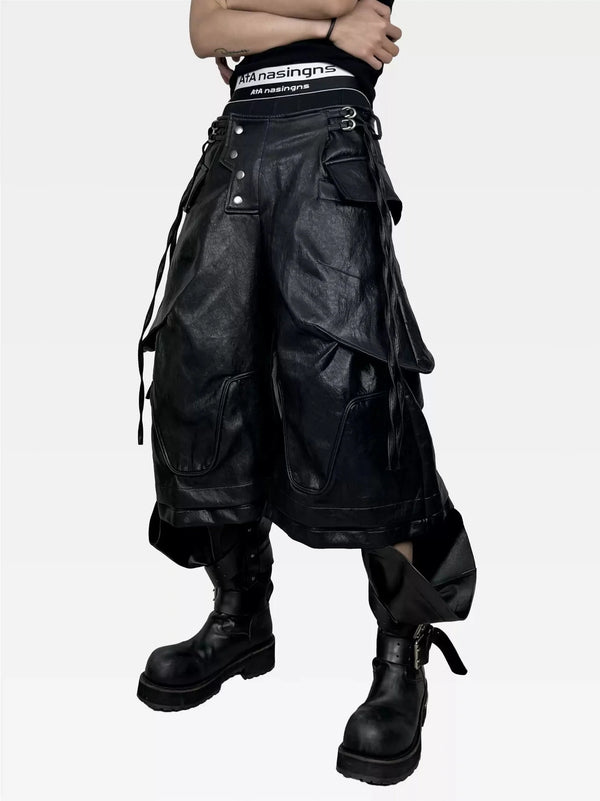
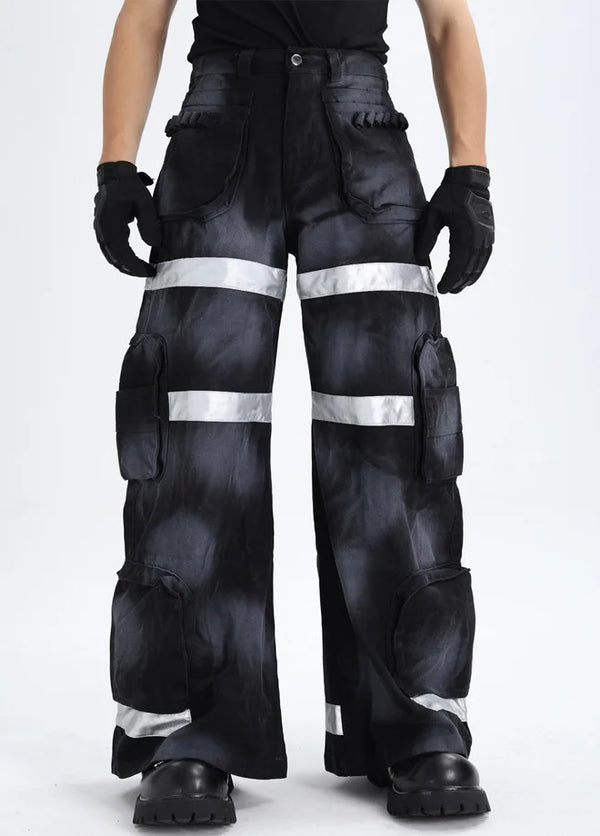
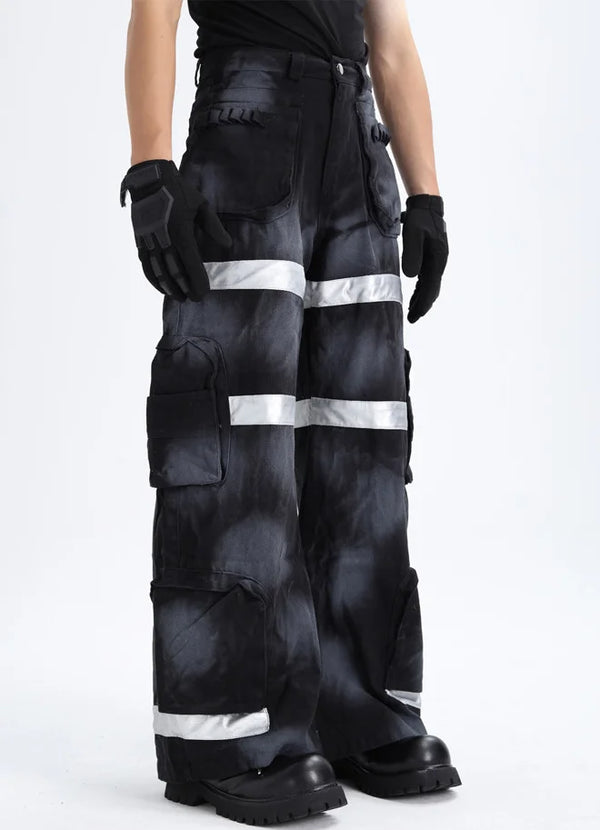
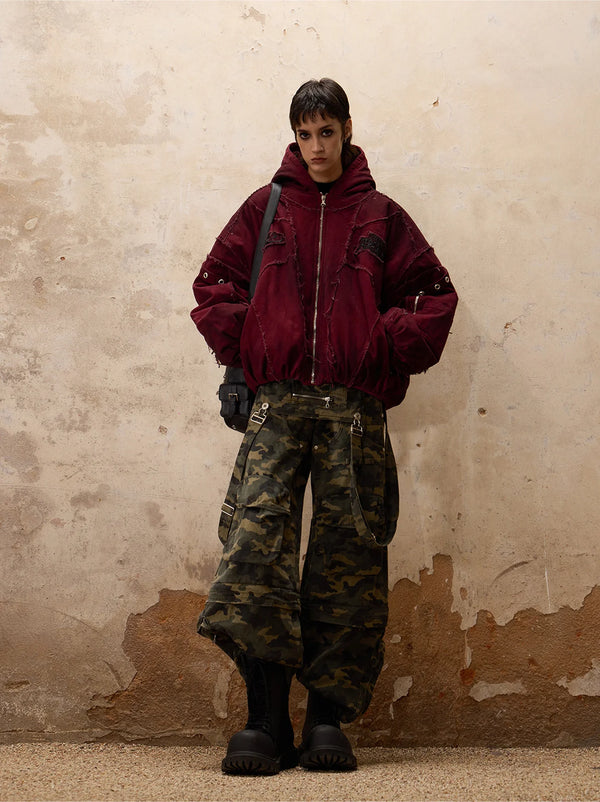
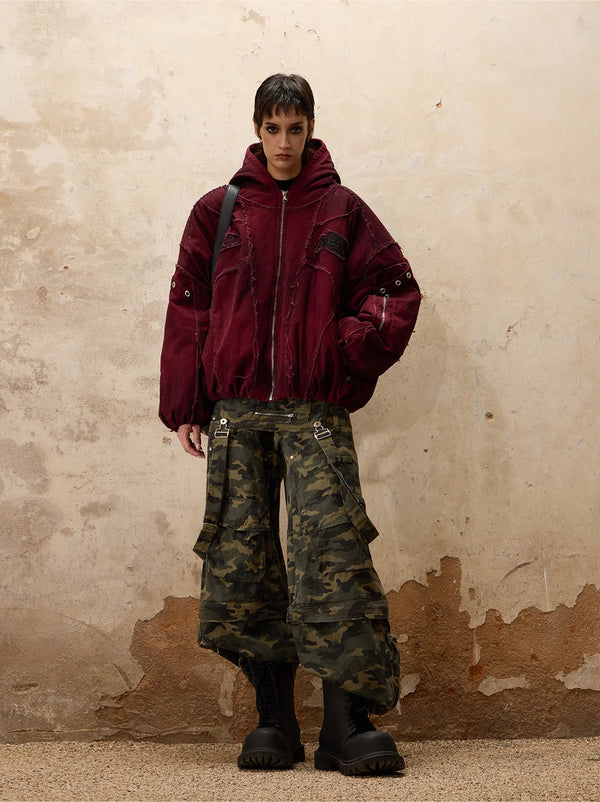
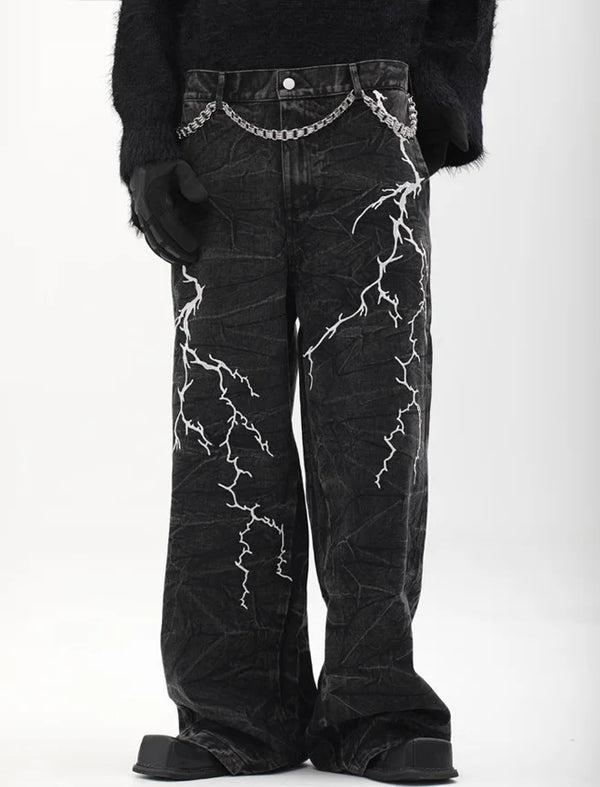
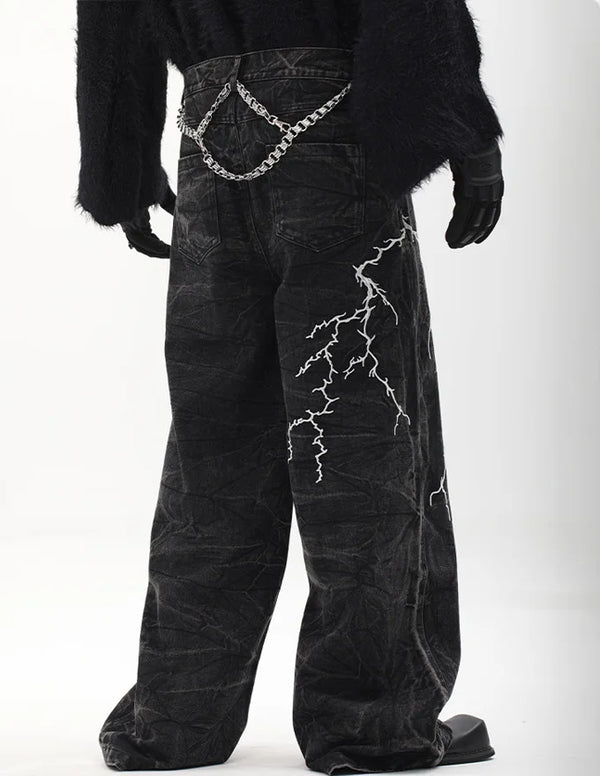
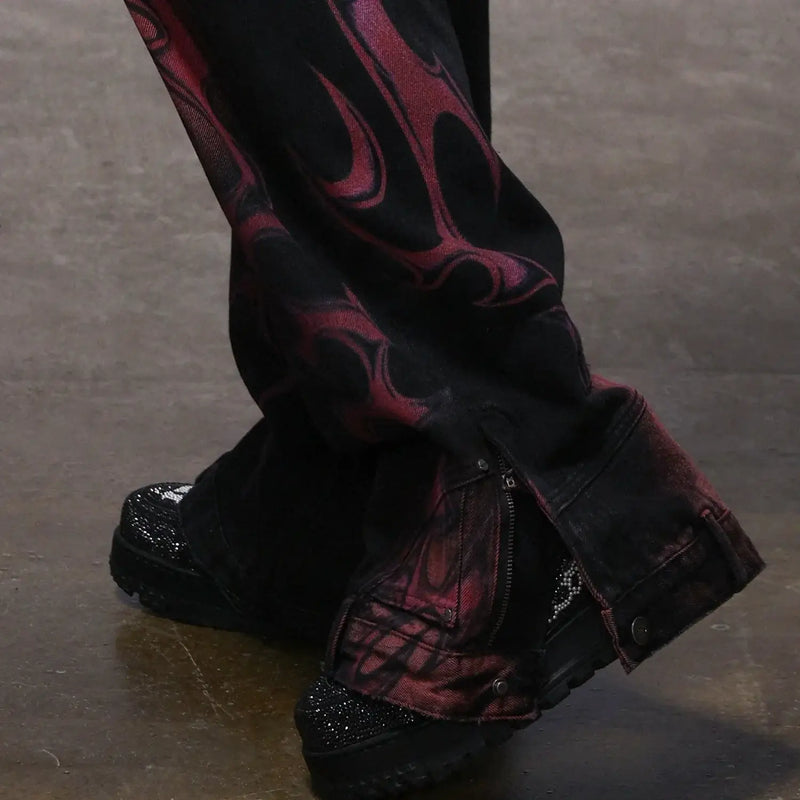
Cyber Goth pants — wide-leg, cargo-strap, vinyl
Cyber Goth never went along with the skinny pant. Even in the 2000s, when skinny was everywhere, the industrial clubs held on to wide-leg — for the simple reason that tight on the leg doesn't work with sweat in the club. Vinyl pants sweat extremely; wide-leg lets air through.
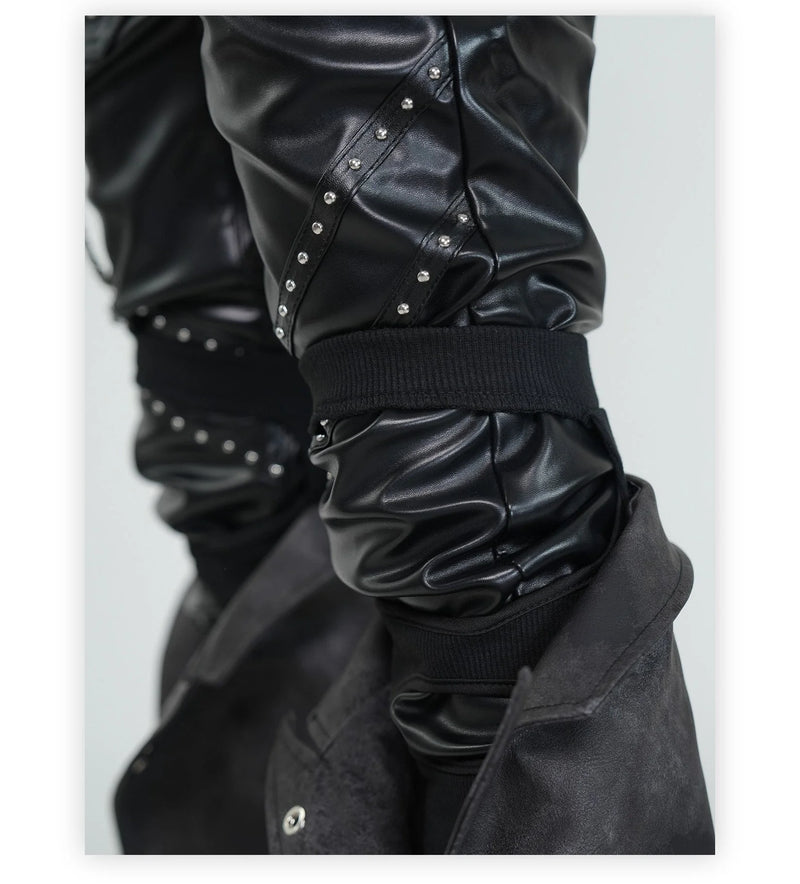
Working Cyber Goth bottoms are matte-black or PVC-glossy, wide from the knee, sit on the hip and carry strap or carabiner detail. Avoid anything with print (skull-print, spider-web pattern), anything colourful (except the one accent colour), and anything too tailored. Slim-cargo without strap detail reads as workwear, not as cyber.
If you want to build one pair that suits each of the five archetypes, take a black wide-leg cargo with strap detail and carabiner. That's the common denominator between EBM-OG, Hardstyle-Cyber and TikTok-Revival.
Category · Skin layer
Cyber Goth tops — harness, mesh, UV-reactive print
The top is the layer where the outfit wins or falls. In Cyber Goth it's almost always two-part: a base layer directly on the body (mesh tank, body, catsuit top), over it a second layer element (harness, strap-top, crop-hoodie). Solo tops only work if they have an architectural line themselves — so harness-shirts or catsuits.
The rule: matte-black or PVC-glossy in the base, one UV accent spot, no classic print. Skull- or spider-print tips the look into Mall-Goth or Halloween. What works: technical markings (binary codes, glyphs, industrial logos), monochrome symbols in UV-print, asymmetric cuts.
If you want to test the look without sliding into the catsuit corner, start with a mesh long-sleeve under a strap-harness. That's the easiest entry — and doesn't tip into costume if the harness has the right shoulder width.
Category · Footwear & Hardware
Cyber Goth shoes & hardware — platform boots and chrome accessories
In Cyber Goth, shoes aren't a matter of taste but a materials test. A night at Berghain is twelve hours on concrete. A Defqon.1 night is sixteen hours on stamped ground. Sneakers, stiletto, plain boots — all three give up after three hours. Platform boots with a thick rubber sole are the only shoe type that goes the distance.
What works: Demonia Trinity or Reactor (5-8 cm platform), New Rock Reactor or Tank (the heavier EBM variant), Dr. Martens 1490 or Jadon with a plate add-on. All matte-black with chrome detail on the shaft or sole. On jewellery: goggle-glasses as an optional statement, plus a spike-choker, a studded-cuff or a wallet-chain. Three hardware elements max, otherwise it tips into dressing up.
If you wear only platform boots and exactly two hardware pieces, you've already got the look half done. As with any disciplined aesthetic: more is less.
Hair & Face
Cyber Goth hair and make-up — where the outfit becomes architecture
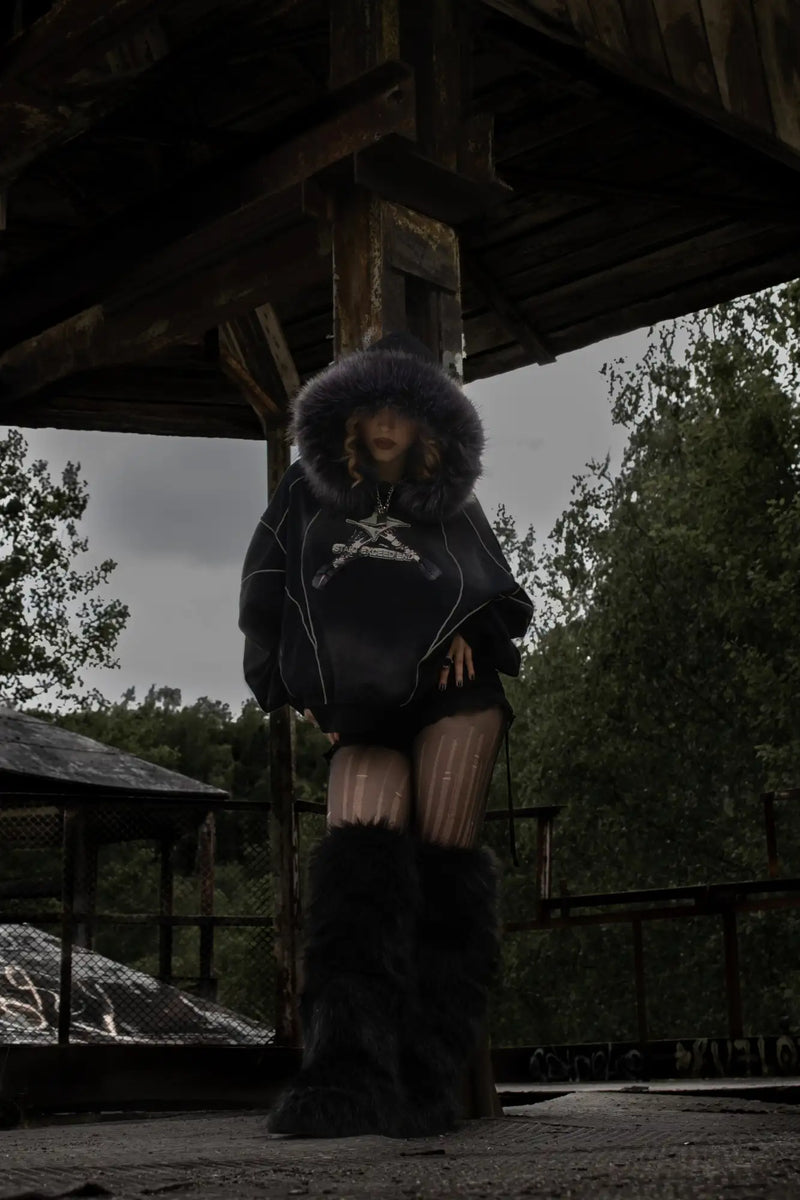
Cyber Goth hair isn't a hairstyle. It's a construction element. Cyberlocks (synthetic falls from melted Kanekalon), synth-dreads, half-falls, tube-crowns — all four add three to five centimetres to the head's height and two to six centimetres to its width. Without hair-architecture a Cyber Goth outfit looks like a well-meant Goth outfit that's missing the height.
The outfit doesn't stop at the collar. It goes twenty centimetres further up — and that's mandatory, not optional.
Three hair options are standard in the scene. First: synth-Cyberlocks in black with a single accent strand. Second: half-shave plus twin-tail with falls in black and the accent colour. Third: a short top with liberty spikes or mohawk, single-colour black or with a UV-reactive tip. All three work without a professional stylist — falls get pinned in, Cyberlocks clipped.
Make-up carries the second half of the architecture. Black concealer lips, a black eyeliner wing wide to the temples, an accent line under the eye in the same colour as the hair strand. Glossy is wrong; matte is right. UV-reactive eyeshadow as an optional detail, but only in one spot — usually inner eye corner or centre of the forehead. A full-surface neon face tips into carnival.
Cyber Goth doesn't stand alone. It overlaps at several edges with other dark and night-oriented aesthetics. Industrial-techno shares the black base, Berlin-techno shares the stomp-boots vocabulary, cyberpunk-techwear shares the chrome detail, rave-wear in general shares the UV-accent logic. Anyone who's got Cyber Goth down can read these codes and mix them deliberately without sliding into costume territory.
Here are the four neighbour codes — each with its own guide, if you want to go deeper:
Setting
Where you actually wear Cyber Goth — Berghain, Wave-Gotik-Treffen, J-Cyber clubs
Cyber Goth is club-, festival- and night-specific. Daylight Cyber Goth works, but only stripped down — platform boots plus black wide-leg plus mesh long-sleeve, without hair-architecture. The full iteration with falls, UV make-up and strap-harness belongs in specific rooms.
The five places where the whole system sits: Berghain (every Saturday, EBM-OG and Industrial-Goth work best); the Wave-Gotik-Treffen in Leipzig (Whitsun, all five archetypes allowed, the festival with the highest discipline level); Defqon.1 in Holland (Hardstyle-Cyber default, shortest hemlines, highest UV ratio); Japanese J-Cyber clubs in Shibuya and Shinjuku (mini-skirt plus catsuit mandatory); and punk or EBM nights in Brooklyn, London, Berlin (small rooms, EBM-OG at its densest).
Cyber Goth is also one of the few aesthetics that works better in winter than in summer. Long coats, plate-carrier, strap-layer — all of it reads as logical at minus 5 degrees, as a materials trial at plus 30.
Here's what that looks like in motion — an iteration that sits between Industrial-Goth and Hardstyle-Cyber:
What does not work
The 6 most common Cyber Goth mistakes — what you must NOT do
Cyber Goth has six spots where it reliably tips — no matter how much money sits in the individual pieces. If you avoid only one thing, make it mistake number one.
Action
Cybergoth outfit dress to impress — how to start with 4 pieces
You don't need 25 Cyber Goth pieces to start. You need four that are in 80 percent of all outfits. Everything else builds around them.
In order: a pair of platform boots (your biggest investment, lasts five years of club nights). A black wide-leg cargo with strap detail. A black mesh long-sleeve or catsuit top. A strap-harness or spike-choker as a visible hardware statement. The UV accent colour comes only after that — as an optional fifth, once the four sit.
Outfits for real
Cyber Goth outfits for real — how it looks on the dancefloor
Before you build your own outfit, look at how others wear it. The five archetypes look different in the feed than in studio photos: sweatier, closer to the body, less perfect — and that's exactly why they work on the floor.
It's the fastest way to test whether Cyber Goth even sits on your body type — before you invest money in falls and platform.
To close
Cyber Goth is architecture — not a dress-up trick
If you remember one thing from this guide, make it this: Cyber Goth doesn't work off the number of pieces but off their distribution. Anyone with five building blocks sitting cleanly builds forty outfits from fifteen items. Anyone with a box full of neon pieces has not a single look that holds out until sunrise.
The whole logic of this guide reduces to one sentence:
The rules have been stable since the late 90s, and they'll stay that way as long as industrial clubs exist. You don't have to wait until you know all three archetypes by heart. Start with the one look that suits your home club — Berghain means EBM-OG, Defqon.1 means Hardstyle-Cyber, Wave-Gotik-Treffen means Industrial-Goth. What you don't know, you learn by wearing it.
And that's the point too: Cyber Goth reads in theory like a rulebook but doesn't feel like one in practice. Once you've got the five building blocks down, every further outfit is a variation of the same four or five categories — not a new invention.
FAQ
Frequently asked questions about Cyber Goth rave outfits
The questions we regularly get by DM and email — short, clear, no detour.
What's the difference between Cyber Goth and normal Goth?
Where can you buy Cyber Goth clothing online without getting carnival material?
Is Cyber Goth hair real — or synthetic?
Does Cyber Goth also work for men — or is it a purely women's aesthetic?
Is Cyber Goth the same as cyberpunk?
Which shoes work besides platform boots?
Can I wear Cyber Goth without going to Berghain?
What do you think?
Tell us on @fuga_studios
About the author
Philipp Fuge — Founder · Berlin
Founder of Fūga Studios. Writes the journal himself. Berlin · Shanghai · Tokyo · Poznań — four cities, one logic.